Showing posts with label testing. Show all posts

Friday, December 28, 2018

Delivery pipelines for CDNs

https://www.fastly.com/network-map
In the last couple of years I have integrated Content Delivery Networks into various eLife applications, managing objects ranging from static files and images to dynamic HTML. These projects mainly consisted of:
  • implementing Infrastructure as Code for these CDNs inside the Github repositories we already use for all other cloud resources (AWS and GCP)
  • effectively authorize HTTPS on the CDN side, which will be impersonating your origin servers
  • create instances of the same CDN services, first in testing and then in production environments, keeping them in parity with each other
  • expand end-to-end testing (the tip of the pyramid) to cover also the CDNs rather than just covering the applications involved
  • integrate logging in order to catch any problem happening between the user and the origin servers
  • finally phase in the new CDNs with new geotagged DNS entries
Our first implementation from 2016 was widely integrated into AWS and as such CloudFront was the chosen solution. We subsequently switched to Fastly for all ordinary traffic, experiencing a general increase in features, customization and expenses. What follows is a comparison that isn't just meant to orient the reader between CloudFront and Fastly, but also against the third option of not using a CDN at all. In fact, there are many concerns that may be glossed upon but that you need to take into account seriously when you move your web presence from a few origin servers to a global network of shared, locked down servers managed by an external organization.

Infrastructure as Code

Our AWS-based setup is making a large use of CloudFormation, the native service for declaratively specifying resources such as servers, load balancers and disks. The simple setup has been augmented over the years by a code generation layer for the CloudFormation templates; this Python code reduces duplication between the various templates by starting from standard EC2/ELB/EBS resources that can be customized in size and other parameters.
If we start from a simple single-server setup for a microservice (this was before Docker containers got stable enough), we are looking at a template containing at least an EC2 instance and a DNS entry pointing to it. With multiple servers, we expand this with a load balancer that pulls in a TLS certificate provided to IAM by an administrator.
To configure CloudFront via CloudFormation, an additional resource for the CDN distribution is introduced. All the configuration you need will be visible in this resource, a JSON dictionary or XML tag respecting a certain schema.
Since CloudFormation can only manage AWS resources and nothing outside that tended garden, Fastly was the reason for introducing Terraform alongside it. Whereas almost anything AWS-specific still goes through CloudFormation, Terraform has opened up new roads such as Infrastructure as Code implementations for Google Cloud Platform (storage buckets and BigQuery tables).
Applying changes in this context is not trivial as you may inadvertently reboot or destroy a server while believing you were only changing a minor setting. Yet Infrastructure as Code is about making the current state of infrastructure and all changes visible, easy to review and safe to rollout across multiple environments. It is imperative therefore to maintain testing environments created with the same tooling as production, and to use them to ultimately integration test all changes.
The caveat of using multiple tools in lockstep for the same instance of a project (including servers, cloud resources and CDNs) is that they can't declare dependencies between resources managed by different tools. For example, since we manage DNS in CloudFormation and Fastly CDNs in Terraform, we can both at the same time but can't couple together the existence of a DNS and the CDN it points to, or impose a creation or update order that is different from the general order we run the tools in.
The most glaring difference in updates rollout between the various options is that, to rollout a CDN configuration change, it takes:
  • no deployment time if you don't use a CDN (obviously)
  • 10s of seconds for Fastly
  • 10s of minutes (up to 1 hour was common) for CloudFront
This means Fastly opens up the possibility for experimentation, even if with a slower feedback that your local TDD cycle. With CloudFront this is painful and haphazard as you decide on a change, start applying it and come back one hour later to check its effects, after having already switched to another task.
Still, minutes of update and/or creation time make Fastly unavailable for inclusion in the CI environments where the tests of a single service are run. You could in theory create a Fastly service on the fly when the build of the service runs, but this will add minutes to your build _and_ also promote coupling to the CDN itself. Fast forward this a bit and you'll see an application unable to be run locally anymore for exploration because of the missing CDN layer. Therefore, like cloud services the CDN is treated like a long-lived resource, with its regression testing performed into a shared environment on every new application commit, but after merge.

Logging

Within a web service, you usually have some kind of access log being generated by nginx or Apache. These logs can sit on a single server or can be uploaded to some aggregation point, whether it is a local Logstash or an external platform that can index them.
Even load balancing doesn't change this picture very much as the load balancer(s) logs should be identical to the ones of the application servers if everything is working well. But with a CDN, large-scale caching is introduced and so it's plausible that you will stop directly seeing a large percentage of your traffic. Statistics or monitoring based on access logs may get skewed; or worse, Japan may be cut off from your website for a while because the health checks from the CDN points of presence there have a timeout of a few milliseconds too low to get to your servers in us-east-1 (of course this never happened).
Hence, to understand what's going on in those few hundred servers you have no access to, you need a way to stream them to some outsourced service; this can be storage as a service (S3 or GCS) or directly some log infrastructure provider. The latency with which logs can get in the right place is a key metric of the feedback loop from changes.
Since we are striving for Infrastructure as Code, all the logging configuration should be kept under version control together with hostnames and caching policies. We got to a standard logging format (JSON Lines with certain fields) and frequency, along with GCS bucket where to put new entries, bucket names following conventions. This was later expanded into BigQuery tables providing queries over the same data, after the Terraform Fastly provided started supporting this delivery mechanism.
The main difficulty in integration was credentials management: you aren't told much if credentials are not correct or not authorized to perform certain actions like writing to BigQuery. Moreover, you can't just commit a bunch of private keys for anyone to see, especially since Infrastructure as Code repositories tend to be made very visible to as many people as possible.
We ended up putting GCP credentials and similar secrets in Vault, running on the same server as the Salt master (same thing as Puppet master). The GCP Service Account itself and its permissions to write to the bucket needed some special permissions to set up (it's turtles all the way down) so couldn't put it directly into Infrastructure as Code but had an admin manually creating it instead. The ideal thing would be for Vault to generate credentials by itself, following the pattern of periodically rotating them. But then it would need to push these credentials somehow into the Fastly configuration and I'm here to provide efficient delivery pipelines, not make cloud giants wrestle.

Flexibility

Your own application is usually highly customizable, with a certain cost associated. You have to write some code in your favorite programming language, possibly following some framework conventions and calling your classes Middleware or EventListener.
CDNs work on shared servers, so they have limits on what can be safely run in that sandboxed environment. Nevertheless, Fastly provides the possibility to customize the VCL that runs each service with your own snippets and macros.
This is very flexible, perhaps even too much: you can introduce headers with random values, write conditionals and implement loops by restarting requests. It feels similar to working in nginx configurations but with a more predictable language.
The main problem with this form of customization is that there is no way to run it or test it on your own. The best feedback loop we found is the Fastly Fiddle (similar to JS Fiddle) where you test out bits of code, hit a save button and see it propagated to servers around the world for you to test.
The fact that this even exists is impressive, but you can imagine how well it works for actual development. Once you get past experimenting, you can't integrate a Fiddle with your own Infrastructure as Code approach (e.g. Terraform templates) nor easily port code from one to another besides copying and pasting. You can run integration-only tests in some other window, but the feedback loop can't be shorter than the deployment time; unit tests are not a thing. You can't even use your IDE as much as you may love it. In the end, Fastly's Varnish diverged from the open source one 4 major versions ago; hence, this VCL is a proprietary language and you'll feel the same as writing stored procedures in Oracle's PL/SQL.
I tend to see VCL and other intermediate declarative templates (such as Terraform .tf files) as a generation target for Infrastructure as Code to compile to. This lets you unit test that your tools generate a certain output for these templates; use dummy inputs in tests and check dummy expected outputs; all of this will still need to be integration tested with the application itself in a real environment, but some of the responsibilities can be developed in the tool itself and reused across many applications.

Integration testing

We have understood by now that to keep the ensemble of servers, code, cloud services and CDNs we need some automated integration testing in place that touches all the different pieces. We don't want many scenarios to be tested at this level because it's slow and brittle to do so, but we need a tracer bullet that goes through everything, if only to verify all configurations are correct.
In the general context of outsourcing of responsibilities to a service or a library, you still own it as a dependency of your application and still need to verify the emergent behavior of custom code and borrowed architecture.
Therefore, I always put at least a staging environment in place replicating production where automated tests can run. This doubles as the place where to try and roll out infrastructure updates that are risky (which are risky? If you have to ask, all of them; just roll out everything through staging).
As we have seen, creating too many different, ad-hoc environments to test pull requests doesn't scale; this will reach death by feature branch as all of your Jenkins nodes are waiting for yet one more RDS node or CloudFront distribution to be created.
A common example of a coupled, integration-related feature to test is the forwarding of Host and other headers; these go through so many layers: a couple of CDN servers, a load balancer, an nginx daemon and finally the application. Some headers don't just have to be forwarded, but have to be rewritten or renamed or added (X-Forwarded-For). All of this can in theory be specified for every single layer but testing the whole architecture probably makes for easier long-term maintenance.

Why?

In various projects you always have to ask yourself why you are doing something (especially complex things) and what value you want to get out of it. CDNs are one of the go-to solution for web performance, their killer feature being huge caches for slow-changing HTML and assets across the world so that even a casual Indian reader can load your homepage in one second. Moreover, if done right the load on your origin servers will also be greatly reduced with respect to not using caching layers.
On the other hand, you can see the complexity, observability and maintenance needs that every additional layer introduces. When asking whether a CDN should do something or your application should do something, it's the same decision as for a database or a cloud service: how can you effectively store and update its configuration in multiple environments? Do you want to oursource that responsibility? How will you know when something's wrong? Do you feel comfortable writing stored procedures in a language you can't run on your laptop? All of these are architectural questions to go through when evaluating various CDNs, or no CDN.

Sunday, September 16, 2018

Eris 0.11.0 is out

Eris 0.11.0 has been freshly released, and I'll be listing here various contributions that the project has received that are included in this new version and in the previous one, 0.10.0, which didn't have an associated blog post.

For a full list and links to the relevant pull requests and commits, see the ChangeLog.

0.10

  • The Eris\Facade class was introduced to allow usage outside of a PHPUnit context.
  • Official PHPUnit 7 support was introduced.
  • Fixed a corner case in suchThat()
There are some small backward compatibility breaks with respect to 0.9; they regard unused features (or at least I thought) including Generator::contains().

0.11

  • Official PHP 7.2 support
  • Annotations support for configuring behavior that is usually configured through methods: @eris-method, @eris-shrink, @eris-ratio, @eris-repeat, @eris-duration

Some acknowledgements

Most of this work comes from contributions, not from me. I'd like to say a word of thanks to the people that have taken the time to use Eris in some of their projects but also to feed back a fix, an extension, or a substantial improvement.

Monday, April 03, 2017

Pipeline Conf 2017

Not liquorice
Post originally shared on eLife's internal blog, but in the spirit of (green) open access here it is.

Last month I have attended the PIPELINE conference in London, 2017 edition. This event is a not-for-profit day dedicated to Continuous Delivery, the ability to get software changes into the hands of users, and to do so safely, quickly, and in a sustainable way. It is run by practitioners for practitioners, everyone on different sides of the spectrum like development, operations, testing, project management, or coaching.

The day is run with parallel tracks, divided into time slots of 40-minute talks and breaks for discussions and, of course, some sponsor pitches. I have been picking talks from the various tracks depending on their utility to eLife's testing and deployment platform, since our tech team has been developing every new project with this approach for a good part of 2016.

The conceptual model of Continuous Delivery and of eLife's implementation of it is not dissimilar to the scientific publishing process:
  • there is some work performed into an isolated environment, such as a laboratory, but also someone's laptop;
  • which leads to a transferable piece of knowledge, such as a manuscript, but also a series of commits, roughly speaking some lines of code;
  • which is then submitted and peer reviewed. We do so through pull requests, which perform a series of automated tests to aid human reviewers inside the team; part of the review is also running the code to reproduce the same results on a machine which is not that original laptop.
  • after zero or more rounds of revisions, this work gets accepted and published...
  • which means integrating it with the rest of human knowledge, typesetting it, organizing citations and lots of metadata about the newly published paper. In software, the code has to be transformed into an efficient representation, or virtual machines have to be configured to work with it.
  • until, finally, this new knowledge (or feature) is in the hands of a real person, who can read a paper or enjoy the new search functionalities
Forgive me for the raw description of scientific work.

In software, Continuous Delivery tries to automate and simplify this process to be able to perform it on microchanges multiple times per day. It aims for speed to be able to bring a new feature live in tens of minutes; it aims for safety to avoid breaking the users work on new changes; and to do all of this in a sustainable way, not to sacrifice tomorrow's ability to evolve for a quick gain today.

Even without the last mile of real user traffic, the 2.0 software services have been running in production or production-like servers from the first weeks of their development. A common anti-pattern in software development is to say "It works on my machine" (imagine some saying "It reproduces the results, but only with my microscope"); what we strive for is "It works on multiple machines, that can be reliably created; if we break a feature we know within minutes and can go back the latest version known to work."

Dan North: opening keynote

Dan North started to experiment with Continuous Delivery in 2004, at a time when builds were taking 2 days and a half to run in a testing environment contended by multiple teams. He spoke about several concepts underpinning Continuous Delivery:
  • conceptual consistency: the ability of different people to make similar decisions without coordination. It's an holy grail for scaling the efforts of an organization to more and more members and teams.
  • supportability: championing Mean Time To Repair over Mean Time Between Failures. The three important questions for facing a problem as what happened? Who is impacted? How do we fix it?
  • operability: what does it feel like to build your software? To deploy it? Test it? Releasing it? Monitor it? Support it? Essentially, developer experience in additio to user experience.
Operability is a challenge we have to face ourselves more and more as we move from running our own platform to provide open source software for other people to use. Not only reading an article has to be a beautiful experience, but publishing one should be.

John Clapham: team design for Continuous Delivery

This talk was more people-oriented, I agree with the speaker that engagement of workers is what really drive profits (or value in case of non-profits).
Practically speaking:
  • reward the right behaviors to promote the process you want;
  • ignore your job title as everyone's job is to deliver value together;
  • think small: it's easier to do 100 things 1% better than to do 1 thing 100% better (aka aggregation of marginal gains)

Abraham Marin: architectural patterns for a more efficient pipeline

The target for a build is for it to take less than 10 minutes. The speaker promotes the fastest builds as the one you don't have to run, introducing a series of patterns (and the related architectural refactorings) to be executed, safely, to simplify your software components:
  • decoupling an api from implementation: extracting an interface package to reduce the dependencies to a component to a dependency to an interface;
  • dividing responsibiliteis vertically or horizontally trying to isolate the most frequent changes and minimizing cross-cutting requirements;
  • transform a library into a service;
  • transform configuration into a service.
Some of these lessons are somewhat oriented to compiled languages, but not limited to them. My feeling is that even if you reduce compile times, you still have to test some components in integration, which is a large source of delay.

Steve Smith: measuring Continuous Delivery

How do you know whether a Continuous Delivery effort is going well? Or more pragmatically,  which of your projects is in trouble?
The abstract parameters to measure in pipelines are speed (throughput, cycle time) and stability. Each declines differently depending on the context.
In deployment pipelines that go from a commit to a new version release in production, lead time and the interval of new deployments can be measured. But also failure rate (how many runs fail) and failure recovery time are interesting. In more general builds or test suites, execution time is a key parameter but a more holistic view includes interval (how frequent are builds executed).
I liked some of these metrics so much that they are now in my OKRs for the new quarter. Simplistic quote: you can't manage what you can't measure.

Alastair Smith: Test-driving your database

To continuously deploy new software versions, you need an iterative approach to evolve your database and the data within it. When you evolve, you also have to test every new schema change. Even in the context of stored procedures for maximum efficiency (and lock-in), Alastair showed how to write tests that can reliably run on multiple environments.

Rachel Laycock: closing keynote, Continuous Delivery at Scale

Rachel Laycock is the Head of technology for North America at Thoughtworks, the main sponsor of the conference. The keynote however had nothing to do with sales pitches. Here are some anti-patterns:
  • "We have a DevOps team" is an oxymoron, as that kind of team doesn't exist; what often happens is that the Ops team gets renamed."
  • Do we chose Kubernetes or Mesos?" as in getting excited about the technology before you understand the problem to solve.
The "at scale" in the title pushes for seeing automation as a way to build a self-serving platform, where infrastructure people are not bottlenecks but enablers for the developers to build their own services.
The best quote however really was "yesterday's best practice becomes tomorrow's anti-pattern". What we look for is not to be the first to market but to have an adaptable advantage, a product that can evolve to meet new demands rather than being a dead end.

Sunday, March 12, 2017

Eris 0.9.0 is out

In 2016 I moved to another country and as a result of this change I didn't had much time to develop Eris further. Thankfully Eris 0.8 was already pretty much stable, and in this last period I could pick up development again.

What's new?

The ChangeLog for 0.9 contains one big new feature, multiple shrinking. While minimization of failing test cases is usually performed with a single linear search, multiple shrinking features a series of different options for shrinking a value.
For example, the integer 1234 was usually shrunk to 1233, 1232, 1231 and so on. With multiple shrinking, there are a series of options to explore that make the search logarithmic, such as 617, 925, 1080, 1157, 1195, 1214, 1224, 1129, and 1231. If the simplest failing values is below 617 for example, at least (1234-617) runs of the test will be skipped by this optimization, just in the first step.
This feature is the equivalent of QuickCheck's (and other property-based testing libraries') Rose Trees, but implemented here with an object-oriented approach that makes use of `GeneratedValueSingle` and `GeneratedValueOptions` as part of a Composite pattern.

This release also features support for the latest versions of basic dependencies:
  • PHPUnit 6.x is now supported
  • PHP 7.1 is officially supported (I expect there were mostly no issues in previous releases, but not the test suite fully passes.)
Several small bugs were fixed as part of feedback from projects using Eris:
  • the pos() and neg() generators should not shrink to 0.
  • float generation should never divide by 0.
  • shrinking of dates fell into a case of wrong operator precedence.
  • reproducible PHPUnit commands were not escaped correctly in presence of namespaced classes.
A few backward compatibility fixes were necessary to make room for new features:
  • minimumEvaluationRatio is now a method to be called, not a private field.
  • GeneratedValue is now an interface and not a class. This is supposed to be an internal value: project code should never depend on it and it should build custom generators with map() and other composite generators rather than implementing the Generator interface, which is much more complex.
  • the Listener::endPropertyVerification() method now takes the additional parameters $iterations and the optional $exception. When creating listeners should always subclass EmptyListener in order not to have to modify the not implemented methods, which will be inherited.

What's next?

My Trello board says:
  • still decoupling from PHPUnit, for usage in scripts, mainly as a programmable source of randomness.
  • more advanced Generators for finite state machines and in general a more stateful approach, for testing stateful systems.
  • faster feedback for developers, like having the option to run fewer test cases in a development environment but the full set in Continuous Integration.
I'm considering opening up the Trello board for public read-only visibility, as there's nothing sensible in there, but potential value in transparency and feedback from the random people encountering the project for the first time.

As always, if you feel there is a glaring feature missing in Eris, feel free to request it on the Github's project issues.

Sunday, February 12, 2017

Book review: Fifty quick ideas to improve your tests

https://leanpub.com/50quickideas-tests
Fifty quick ideas to improve your tests is, well, a series of fifty quick ideas that you can implement on some of your automated test suites to improve their value or lower their creation or maintenance costs.

These ideas are pattern-like in which they are mostly self-contained and often independent from each other. They are distilled from real world scenarios that the authors (David Evans, Tom Roden and Gojko Adzic) have encountered in their work.

This format helps a lot readability, as ideas are organized into themes, giving you the ability to focus on the area you want to improve and to quickly skip the ideas that do not make sense in your context or you find impractical or not worth the effort. For the same reasons I enjoyed the book this one is a sequel to, Fifty quick ideas to improve your user stories. Moreover, both were published on Leanpub so you have the ability to adjust the price to the value you think you'll get out of them; and despite Leanpub's large collection of unfinished books, this one is 100% complete and ready to read without the hassle of having to update to a new version later (who really does that?)

Some selected quotes follow, highlighted phrases mine.
Something one person considers critical might not even register on the scale of importance for someone from a different group. 
Drawing parallels between the different levels of needs, we can create a pyramid of software quality levels: Does it work at all? What are the key features, key technical qualities? Does it work well? What are the key performance, security, scalability aspects? Is it usable? What are the key usability scenarios? Is it useful? What production metrics will show that it is used in real work? Is it successful? 
In order to paint the big picture quickly, we often kick things off with a ten-minute session on identifying things that should always happen or that should never be allowed. This helps to set the stage for more interesting questions quickly, because absolute statements such as ‘should always’ and ‘should never’ urge people to come up with exceptions. 
Finally, when an aspect of quality is quantified, teams can better evaluate the cost and difficulty of measuring. For example, we quantified a key usability scenario for MindMup as ‘Novice users will be able to create and share simple mind maps in under five minutes’. Once the definition was that clear, it turned out not to be so impossible or expensive to measure it.
Avoid checklists that are used to tick items off as people work (Gawande calls those Read-Do lists). Instead, aim to create lists that allow people to work, then pause and review to see if they missed anything (‘Do-Confirm’ in Gawande’s terminology). 
A major problem causing overly complex examples is the misunderstanding that testing can somehow be completely replaced by a set of carefully chosen examples. For most situations we’ve seen, this is a false premise. Checking examples can be a good start, but there are still plenty of other types of tests that are useful to do. Don’t aim to fully replace testing with examples in user stories – aim to create a good shared understanding, and give people the context to do a good job. 
Waiting for an event instead of waiting for a period of time is the preferred way of testing asynchronous systems
The sequence is important: ‘Given’ comes before ‘When’, and ‘When’ comes before ‘Then’. Those clauses should not be mixed. All parameters should be specified with ‘Given’ clauses, the action under test should be specified with the ‘When’ clause, and all expected outcomes should be listed with ‘Then’ clauses. Each scenario should ideally have only one ‘When’ clause that clearly points to the purpose of the test.
Difficult testing is a symptom, not a problem. When it is difficult for a team to know if they have a complete picture during testing, then it will also be difficult for it to know if they have a complete picture during development, or during a discussion on requirements. It’s unfortunate that this complexity sometimes clearly shows for the first time during testing, but the cause of the problem is somewhere else. 
Although it’s intuitive to think about writing documents from top to bottom, with tests it is actually better to start from the bottom. Write the outputs, the assertions and the checks first. Then try to explain how to get to those outputs. [...] Starting from the outputs makes it highly unlikely that a test will try to check many different things at once, 
Technical testing normally requires the use of technical concepts, such as nested structures, recursive pointers and unique identifiers. Such things can be easily described in programming languages, but are not easy to put into the kind of form that non-technical testing tools require. 
For each test, ask who needs to resolve a potential failure in the future. A failing test might signal a bug (test is right, implementation is wrong), or it might be an unforeseen impact (implementation is right, test is no longer right). If all the people who need to be make the decision work with programming language tools, the test goes in the technical group. If it would not be a technical but a business domain decision, it goes into the business group. 
Manual tests suffer from the problem of capacity. Compared to a machine, a person can do very little in the same amount of time. This is why manual tests tend to optimise human time [...] Since automated tests are designed for unattended execution, it’s critically important that failures can be investigated quickly. [...] To save time in execution, it’s common for a single manual test to check lots of different things or to address several risks. 
Whenever a test needs to access external resources, in particular if they are created asynchronously or transferred across networks, ensure that the resources are hidden until they are fully complete. 
Time-based waiting [sleep() instead of polling or waiting for an event in tests] is the equivalent of going out on the street and waiting for half an hour in the rain upon receiving a thirty-minute delivery estimate for pizza, only to discover that the pizza guy came along a different road and dropped it off 10 minutes ago. 
Instead of just accepting that something is difficult to test and ignoring it, investigate whether you can measure it in the production environment. 
Test coverage is a negative metric: it measures how bad something is, not how good it is. 
There are just two moments when an automated test provides useful information: the first time it passes and when it subsequently fails. 
It’s far better to optimise tests for reading than for writing. Spending half an hour more writing a test will save days of investigation later on. [...] In business-oriented tests, if you need to compromise either ease of maintenance or readability, keep readability. 

Monday, November 14, 2016

How to run Continuous Integration on EC2 without breaking the bank

I live in a world increasingly made up of services (sometimes micro-), that collaborate to produce some visible behavior. This decomposition of software into (hopefully) loosely coupled components has implications for production infrastructure concern such as how many servers or containers you need to run. 
Consequently, it impacts also testing infrastructure as it tries to be an environment as close as possible to production, in order to reliably discover bugs and replicate them in a controlled environment without impacting real users.
In particular I like to have a ci testing environment where each service can be tested in its own virtual machine (or container for some); and each node is totally isolated from the other services. In addition to that, I also like to have and end-to-end testing environment where services talk to each other as they would in production, and where we can run long and complex acceptance tests. 
This end-to-end environment usually is a perfect copy of production with respect to the technologies being used (e.g. load balancers like HAProx or AWS ELB are in place, in the same way of production, even if there is no test that directly targets their existence); the number of nodes per service is however reduced from N to 2, as in computing there are only 0, 1 and N equivalence categories.

In the likely case that you're using cloud computing infrastructure to manage this 2x or 3x volume of servers with respect to the production infrastructure, your costs are also by default going to double or triple. One option to try and optimize this is to throw away everything and start deploying containers, as they could share the same underlying virtual machines as production while preserving isolation and reproducibility. On an existing architecture made up of AWS EC2 nodes however, optimization can takes us far without requesting to rewrite all the DevOps(TM) work of the last two years.

Phase 1: expand

As I've been explaining, EC2 instances replicating production environments can expand until they bring the total number of EC2 nodes to three times the original number. Some project just have an single EC2 node, while others have multiple nodes that have to be at least 2 in the latest testing environment before production. Moreover, the time the tests take to run on these instances is inversely correlated with how powerful they are in CPU and I/O terms, so you pay good money for every speed improvement you want to get on those 20- or 60-minute suites.
In my current role at eLife, we initially got to more than 20 EC2 instances for the testing environments. This was beneficial from a quality and correctness point of view, as we could then run tests on all mainline branches before they go to production, but also on pull requests, giving timely feedback on the proposed changes without requiring developers to run everything on their machines (that should be an option, not an imperative.)

Phase 2: optimize

The AWS EC2 pricing model works by putting nodes into a running state when you launch them, and by pre-billing one hour of usage every 60 minutes. Therefore, booting existing instances or creating from scratch is going to incur at least a 1-hour cost for each of these events:
  • at boot, 1 hour is billed
  • at 60:00 from boot a new hour is billed,
  • at 120:00 from boot a new hour is billed, and so on
All the EC2 nodes that we have however, use EBS disks for their root volumes. EBS is the block remote storage provided by AWS, and while some generations of instances use local instance storage for their / partition, EBS makes a lot of sense for that partition as it gives you the ability to starting and stopping instances without losing state in between; essentially, it gives you the ability to shutdown and reboot instances when you need without paying EC2 bills for the time in which they are stopped. The only billing being performed is for the EBS storage space, which means AWS has some hard disks in its data centers that has to preserve your instances files, but it allocates new CPU and RAM resources as a virtual machine only when you start the EC2 instance. Therefore, an EBS-backed EC2 instance on your AWS console does not always correspond to a physical place, but it's really virtual as it can be stopped and started many times, moving between racks in the same availability zone while keeping the same data (persisted to multiple disks in other racks) and even private IP address.
Since the process of allocating a new virtual machine and reconfiguring networks to connect everything together has some overhead, this reflects in the boot time necessary to start an EC2 instance, which can be several seconds to be added to the standard boot time for the operating system. This is also reflected in the pricing model, which makes it a bad idea to launch a new EC2 instance for every test suite you need to run: as long as your test suite takes less than 1 hour, you are already paying for a full hour of resources and you would be throwing away. Running 6 builds in an hour would make you pay for 6 hours, which is not what you want.

Phase 2.1: stop them manually

A first optimization that can be performed manually is to stop and start these instances from the console. You would usually stop them at some hour of the day or evening and then start them again as the first thing in the morning.
Of course, there is a good potential for automating this as AWS provides many ways to access EC2 with its API and all the SDKs that build on top of it, available for many different programming languages. You can easily build some commands that query the EC2 API looking for an instance basing on its tags, and then issue commands for starting and stopping it. In general, this is almost transparent for the CloudFormation templates that you are surely using for launching these instances.
The first time you start and stop an instance, there are a few problems thay may come up.
The first problem is that of ephemeral storage: as I wrote before, you have to make sure the root volume of the instance and any data you want to persist are EBS-backed and not local instance storage.
The second problem is that of public IP addresses. While private IP addresses inside a VPC stay the same after a stop and start commands, public IP addresses are a scarce resource and are only allocated to it when the instance is running. Therefore, if you had a DNS pointing to it, it has to be updated after the boot, whether it was manually created or part of the CloudFormation template. Default DNS entries have the form ec2-public-ip-address.compute-1.amazonaws.com which depends on the public ip address and hence does not provide a good indirection.
The third problem is that of long-running processes managed by SysV/Upstart/Systemd: the daemons of servers like Apache, Nginx or MySQL are usually configured to restart upon boot, but if you have written your own deamons or Python/PHP long running processes and are starting them through /etc/init or /etc/init.d configuration, it pays to check everything is in its place again after boot.
The last problem I have found at this level (manual restarts) is about files in /run and /var/run, which are temporary directory used by deamons to place locks and other transient files like a pidfile indicating an instance of that program is running. If you have folders in /run or /var/run, those folder will have to be recreated. Systemd provides the tmpfiles.d option which automatically creates a hierarchy of files, but it's usually just easier (and portable) to have the daemons create their folders (php-fpm does that) or if they are not able to do that, not placing them in /var/run/some_folder_that_will_stop_existing but in /var/run or even /tmp without subfolders.

Phase 2.2: start them on demand

Instead of manually starting EC2 instance or to automate their stopping and starting as a periodical task, you can also start them on-demand as needed by the various builds that need to be run. So whenever project x needs to build a new commit on master or a pull request, you will start the x--ci EC2 instance.
In this case, however, there is a larger potential for race conditions as you may try to run a deploy or any command on an instance before it's actually ready to be used. Therefore, we wrote some automation code that waits for several events before letting a build proceed:
  1. the instance must have gone from the pending to the running state on the EC2 API. This hopefully means AWS has found a CPU and other resources to assign to it.
  2. the instance must be accessible through SSH.
  3. through SSH, we monitor that the file /var/lib/cloud/instance/boot-finished has appeared. This file will appear at each boot when all daemons have been started, as art of the standard cloud-init package.
Once the instance has gone through all these phases, you can SSH into it and run whatever you want.

Phase 2.3: stop them when it's more efficient

Once you have transitioned from starting instances in the last responsible moment, you can do the same for stopping them instead of just wait for the end of the day to shutdown everything.
We now have a periodical job, running every 2 minutes, that takes a list of servers to stop. In parallel, it performs the following routine for each of the EC2 instances:
  • checks if the server has been running for an amount of time between h:55:00 and h:59:59 minutes, where h is some number of hours.
  • if the condition is true, stop the instance before we incur in a new hour being billed.
  • otherwise, leave the instance running: you already paid for this hour so it makes no harm to do so, as the instance can be used to run new builds at no cost.
Therefore, when developers open a dozen pull requests on the same project, only the first starts the necessary instances to run the tests; the other ones are queued behind that and will get access to the same instance, one at a time.

Bonus: Jenkins locks

Starting and stopping instances periodically would be otherwise dangerous if there wasn't a mechanism for mutual exclusion between builds and lifecycle operations like starting and stopping. Not only you don't want to run builds for the same project on the same instance if they interfere with each other, but you definitely don't want an instance to be shutdown while a build is still running.
Therefore, we wrap both these lifecycle operations and builds in locks for resource, using Jenkins Lockable Resources plugin. If the periodical stopping task tries to stop an instance where the build is running, it will have to wait to acquire the lock. This ensures that machines that see many builds do not get easily stopped, while other ones that are idle will be stopped at the end of their already paid hour.

Conclusions

Cloud computing is meant to improve the efficiency with which we allocate resources from someone else's data centers: you pay for what you use. Therefore, with a little persistence provided by EBS volumes you can efficiently pay for the hours that your builds require, and not for keeping idle EC2 instances running every day of the year. Of course, you'll need some tweaking of your automation tools to easily start and stop instances; but it is a surefire investment that can usually save more than half of the cost of your testing infrastructure by putting it at rest in weekend and non-working hours.

Sunday, May 22, 2016

Eris 0.8.0 is out

In the period before my move to Cambridge I got some time to work on Eris, and to use it to test the guts of Onebip's infrastructure. Lots of new features are now incorporated in the 0.8.0 version, along with a modernization of PHP standards compliance carried out by @localheinz.

What's new?

Here's the most important news, a selection from the ChangeLog:
  • The bind Generator allows to use the random output of a Generator to build another Generator.
  • Optionally logging generations with `hook(Listener\log($filename))`.
  • disableShrinking() option.
  • limitTo() accepts a DateInterval to stop tests at a predefined maximum time.
  • Configurability of randomness: choice between rand, mt_rand, and a pure PHP Mersenne Twister.
  • The suchThat Generator accepts PHPUnit constraints like `when()`.
Some bugs and annoyances were fixed:
  • No warnings on PHP 7 anymore.
  • Fixed bug of size not being fully explored due to slow growth.
  • Switched to PSR-2 coding standards and PSR-4 autoloading.
And there were some backward compatibility breaks (we are in 0.x after all):
  • The frequency generator only accepts variadics args, not an array anymore.
  • Removed strictlyPos and strictlyNeg Generators as duplicated of pos and neg ones.                                     
  • Removed andAlso, theCondition, andTheCondition, implies, imply aliases which expand the surface area of the API for no good reason. Added and for multiple preconditions.
Eris is now quite extensible with custom Generators for new types of data; custom Listeners to know what's going on; and even different sources of randomness to tune repeatability and performance.
I believe what's very important about this release is the release of technical documentation. This is not a list of APIs generated by parsing the code, but is a full manual of Eris features, which will be kept up-to-date religiously in the repository itself and rebuilt automatically at each commit.

What's next?

My Trello board says:
  • decoupling from PHPUnit: it should be possible to run Eris also with PHPSpec (already possible but not as robustly as it can be) or in scripts.
  • Multiple possibilities for shrinking, borrowing from test.check rose trees. This feature may speed up the shrinking process and make it totally deterministic.
  • A few more advanced Generators: for example testing Finite State Machines.
If you are using Eris and wanna give feedback, feel free to open a Github issue to discuss. 

Monday, March 14, 2016

On property-based testing a highly concurrent job queue

Exploring Eris
Recruiter is a job queue written in PHP, open sourced by Onebip in its 2.x version. It has been used on some inward facing production services, but following the necessity to roll it out to more and more project, I have started a thorough testing campaigns to flush out possible concurrency bugs.
The job system is composed of a single Recruiter process and multiple Worker processes (moreover any other PHP process can enqueue a job). These processes may run on any machine inside a local network and share a MongoDB database where they collaborate to empty the collection of jobs to do. The design of these multiple collections is carefully tuned for scalability, as in its first version Recruiter used heavier findAndModify operations which is now free of.

Property-based testing

Testing some happy paths such as adding a job and executing it is fine for test-driving the code, but it's nowhere near enough for quality assurance. On system of any appreciable scale and/or quality, testing is a separate additional activity (that can hopefully be performed by developers wearing a different hat, or in any case inside a single cross-functional team.)
To test highly concurrent processes such as a recruiter and its dozens of workers insisting on the same database, we adopted Eris, the open source PHP QuickCheck implementation developed by me and some colleagues. Eris is able to generate random inputs for the System Under Test, according to a specification provided by the tester; it supports property-based testing which drives the system with this input while checking important properties are respected.
In this scenario, we generated a random sequence of actions to perform over these processes, checking invariants and post-conditions of operations. For example, an invariant is there is never more than one recruiter process alive. There are surprisingly few invariants when you work with distributed systems; as another example consider the number of workers registered in the related MongoDB collection. This number is not fixed, as crashed processes may still be present even if dead, as long as the rest of the system didn't detect the crash yet.
One postcondition of the job system is very important: any job enqueued is eventually executed, preferably as soon as possible. In these tests, we focused on testing the correctness of this property and not the performance. We monitor the collection of archived jobs (which have been executed correctly) and check that it fills up with all the jobs we expect. The timeout after which we declare the test failed is tuned to the total number of actions performed, which is random.
There are more advanced approaches such as generating a sequential prefix plus a few parallel sequences of actions. This could give more control over the process and may enable some form of shrinking with better determinism; however we retain a notion of parallelism by creating multiple processes. Unfortunately each run is non-deterministic as processes and the underlying MongoDB instance can be scheduled differently by the operating system, changing the interleave of their operation; therefore shrinking is not possible, or is possible only at the cost of running shrunk sequences multiple times to reliably mark them as passing.

Iteration: random number of jobs, graceful restarts

In the first version of the test, we generated a random number of identical jobs (executing a "echo 42" command), along with a series of restarts of the recruiter and a single worker process using SIGTERM. The jobs were enqueued serially by the test process, along with the restart actions. In theory, the processes intercept the signals and exit after having finished their current cycle of polling or execution.
Here are the bugs that we found:

Iteration: multiple workers

Once the test suite was consistently green, we extended the testing environment by allowing multiple workers to be created and correctly restarted.
We found an additional problem with this extension:

Iteration: crashing workers

We added the possibility of killing a worker with SIGKILL, immediately interrupting it even in the middle of database updates.
The possibility of a worker crashing was already covered by the code. However, we tuned the timeout period after which workers are considered dead while inside the test suite; we set it to dozens of seconds instead of half an hour to allow for sane waiting periods in the test process.

Iteration: crashing the recruiter

Killing the single recruiter process was interesting because it usually takes a lock (in the form of a document inside a MongoDB collection with a unique index) to avoid accidental multiple executions. The process correctly waited on the previous lock to expire before restarting, but...

Iteration: length of jobs

We introduced also a random length for enqueued jobs (sleeping from 0ms to 1000ms instead of executing a fixed command). At this point we did not find additional bugs at the time of this post, with the test suite running for several hours, exploring new random possible sequences of actions.

Final version

The final version of the test composes an Eris Generator that:
  • generates a number of workers to start between 1 and 4.
  • using this number, creates a new Generator that produces a tuple (in this case a pair, which means an array of two elements of disparate types). The tuple contains the number of workers itself and the list of actions.
The list of actions is a sequence of a random number of elements, where each of the elements can in turn be an action representing:
  • a job to enqueue with an expected duration of a positive number of milliseconds
  • a graceful restart of one of the workers
  • a graceful restart of the recruiter
  • a kill -9 on one of the worker processes
  • a kill -9 on the recruiter process
  • a sleep of a number of milliseconds between 0 and 1000
Here is an example of action sequence:

[ACTIONS][PHPUNIT][2016-03-14T12:11:14+01:00] ["enqueueJob",8]
[ACTIONS][PHPUNIT][2016-03-14T12:11:14+01:00] "restartRecruiterGracefully"


While here is a moderately complex example:

[ACTIONS][PHPUNIT][2016-03-14T12:11:59+01:00] ["restartWorkerByKilling",0]
[ACTIONS][PHPUNIT][2016-03-14T12:11:59+01:00] ["restartWorkerByKilling",0]
[ACTIONS][PHPUNIT][2016-03-14T12:11:59+01:00] "restartRecruiterGracefully"
[ACTIONS][PHPUNIT][2016-03-14T12:12:00+01:00] ["enqueueJob",7]
[ACTIONS][PHPUNIT][2016-03-14T12:12:00+01:00] ["restartWorkerByKilling",0]
[ACTIONS][PHPUNIT][2016-03-14T12:12:00+01:00] ["enqueueJob",13]
[ACTIONS][PHPUNIT][2016-03-14T12:12:00+01:00] "restartRecruiterByKilling"
[ACTIONS][PHPUNIT][2016-03-14T12:12:00+01:00] ["restartWorkerGracefully",0]
[ACTIONS][PHPUNIT][2016-03-14T12:12:00+01:00] ["restartWorkerByKilling",0]
[ACTIONS][PHPUNIT][2016-03-14T12:12:00+01:00] "restartRecruiterGracefully"
[ACTIONS][PHPUNIT][2016-03-14T12:12:10+01:00] ["sleep",860]
[ACTIONS][PHPUNIT][2016-03-14T12:12:11+01:00] "restartRecruiterByKilling"
[ACTIONS][PHPUNIT][2016-03-14T12:12:12+01:00] ["restartWorkerByKilling",0]
[ACTIONS][PHPUNIT][2016-03-14T12:12:12+01:00] ["enqueueJob",0]
[ACTIONS][PHPUNIT][2016-03-14T12:12:12+01:00] ["restartWorkerByKilling",0]
[ACTIONS][PHPUNIT][2016-03-14T12:12:12+01:00] ["enqueueJob",5]
[ACTIONS][PHPUNIT][2016-03-14T12:12:12+01:00] "restartRecruiterGracefully"

The parameter in the steps modelled as arrays is the duration of a job, or the number of the worker in case of restarting actions.

The test generates 100 of these sequences (this number is tunable, or can target a time limit). For each of them it creates an empty database, starts the workers and the recruiter, performs the actions and waits for all jobs to be performed. If the timeout for full execution expires, the test is marked as failed and lists the log files to look at to understand what happened. On my machine, the test now terminates in about one hour, with a green bar.

Conclusions

Testing is an important activity and can increase the quality of your software by removing bugs before they can get to one of your customers. Testing is becoming more and more incorporated in the lifes of developers (see Test-Driven Development and Behavior-Driven Development), but for core domains and infrastructure additional activities are required for stress and performance tests comparable to production traffic.
It is however impossible to write by hand tests for all the possible situations; however you can easily build a reasonable model of the input to your system. So let me quote John Hughes in saying "Don't write tests. Generate them"; with property-based testing you can write one test containing one property, and catch dozens of bugs like in this post's case study.

Saturday, January 02, 2016

Building an application with modern Java technologies

Sometimes Java gets a bad rap from Agile software developers, who suspect it to be a legacy technology on par of Cobol. I understand that being the most used language on the planet means there must be projects of any kind out there, including lots of legacy. That said, Java and the JVM are a huge and alive ecosystem producing value in all kind of domains from banking to Android applications and scientific software.

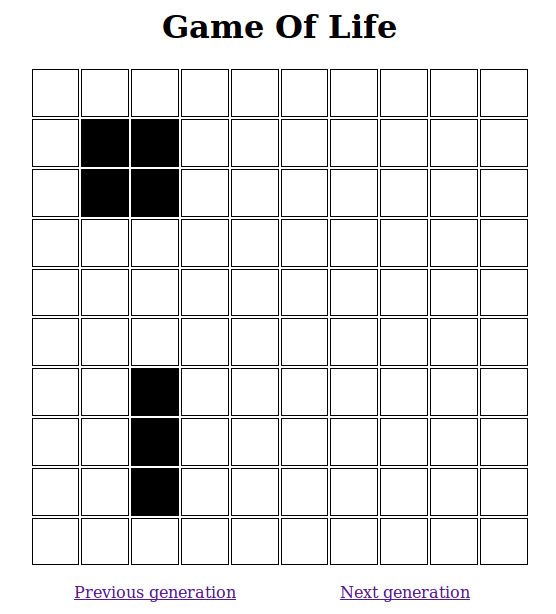
So I built a sample Game Of Life with what I believe are modern Java tecnologies:
  • Java 8 with lambdas support
  • Gradle for build automation and dependency resolution (substitutes both Ant and Maven)
  • Jetty as an embedded server to respond to HTTP requests
  • Jersey for building the RESTful web service calculating new generations of a plane, using JAX-RS
  • Freemarker templating engine to build HTML
  • Log4j 2 for logging, encapsulated behind the interface slf4j.
On the testing side of things:
Here's the result:
The application is self-contained and can be compiled, tested and run without any IDE or previous machine setup except having a JDK 8 on your machine. See the project on Github for details.

Thursday, June 18, 2015

Property-based testing primer

I'm a great advocate of automated testing and of finding out your code does not work on your machine, 30 seconds after having written it, instead of in production after it has caused a monetary loss and some repair work to be performed. This is true for many different kind of testing, from the unit level (which has also benefits for internal quality and design feedback) to the acceptance level (which ensures the stakeholders get what they need and documents it for the future). Your System Under Test can be a single class, a project or even a collaboration of [micro]services accessed through HTTP from another process or machine.

However, classic test suites written with xUnit and BDD styles have some scaling problems they hit when you want to exercise more than some happy paths: 
  • it is difficult to cover many different inputs by hand-writing test cases, so we stick with at most a dozen of cases for a particular method.
  • There are maintenance costs for every new input we want to test: each need some assertions to be written and be updated in the future if the System Under Test changes its API.
  • We tend not to test external dependencies such as the language or libraries, since we trust them to do a good job even if their failure is our responsibility. We chose them and we are deploying our project, not the original authors which provided the code "as is", without warranty.
Note that here I define input as the existing state of a system, plus the new input provided by a test (the Given and When part of a scenario) and output as not only the actual response produced by the System Under Test but also the new state it has assumed.

sort()


Let's take as an example a sort() function, which no one implements today except in job interviews and exercises.
Assuming an array (or list, depending on your language), we can produce several inputs for the function like we would do in a kata:
  • [1, 2, 3]
  • [3, 1]
  • [3, 6, 5, 1, 4]
and so on. When do we stop? Maybe we also need some tricky input:
  • []
  • [1]
  • [1, 1]
  • [2, 3, 5, 6, 8, 9, 1, 3, 6, 7, 8, 9]
Once we have all the inputs gathered, we need to define what we expect for each of them:
  • [1, 2, 3] => [1, 2, 3]
  • [3, 1] => [1, 3[
  • [3, 6, 5, 1, 4] => [1, 3, 4, 5, 6]
  • [] => []
  • [1] => [1]
  • [1, 1] => [1, 1]
  • [2, 3, 5, 6, 8, 9, 1, 3, 6, 7, 8, 9]  => [1, 2, 3, 3, 5, 6, 6, 7, 8, 8, 9, 9]
You can do this incrementally, growing the code one new test case at a time, but you have to do it anyway. Considering this can become boring and error-prone in this toy example makes you wonder what to do when instead of sort() you have a RangeOfMoney class which is key to your business and manages point-like and arbitrary intervals of monetary amounts (true story).

Property-based testing in a nutshell

Property-based testing in an approach to testing coming from the functional programming world. To solve the aforementioned problems (and get new, more interesting ones), it follows these steps:
  1. generate a random sample of possible inputs.
  2. Exercise the SUT with each of them.
  3. Verify properties which should be true on every output instead of making precise comparisons.
  4. (Optionally) if the properties verification failed, possibly shrink to find a minimal input that still causes a failure.

How does this work for the sort() function?

We can use rand() to generate an input array:
This array is composed by natural numbers (Gen\nat) and it is long up to 100 elements (Gen\pos(100)), since very long arrays could make our tests slow.

Then, for each of these inputs, we exercise sort() and verify a simple property on the output, which is the order of the elements:
This is not the only property that sort() maintains, but it's the first I would specify. There are possible others:
  • every element in the input is also in the output
  • every element in the output is also in the input
  • the length of the input and output arrays are the same.
Here is the complete example written using Eris, our extension for PHPUnit that automates the generation of many kinds of random data and their verification.

How to find properties?

How do we apply property-based testing to code we actually write every day? It certainly fits more in some areas of the code than in others, such as Domain Model classes.

Some rules of thumb for defining properties are:
  • look for inverse functions (e.g. addition and substraction, or doubling an image in size and shrinking it to 50%). You can use the inverse on the output and verify equality with the input.
  • Relate input and output on some property that is true or false on both (e.g. in the sort() example than an element that is in one of the two arrays is also in the other)
  • Define post conditions and invariants that always hold in a particular situation (e.g. in the sort() example that the output is sorted, but in general you can restrict the possible output values of a function very much saying it is an array, it contain only integers, its length is equal to the input's length.)

[2, 3, 5, 6, 8, 9, 1, 3, 6, 7, 8, 9] makes my test fail

Defining valid range of inputs with generators and the properties to be satisfied is a rich description of the behavior of the System Under Test. Therefore, when a sort() implementation fails we can work on the input in order to shrink it: trying to reduce its complexity and size in order to provide a minimal failing test case.

It's the same work we do when opening a bug report for someone else's code: we try to find a minimal combination that triggers the bug in order to throw away all unnecessary details that would slow down fixing it.

So in property-based testing the [2, 3, 5, 6, 8, 9, 1, 3, 6, 7, 8, 9] can probably be shrinked to [2, 3, 5, 6, 8, 9, 1, 3, 6, 7, 8] and maybe up to [1, 0], depending on the bug. This process is accomplished by trying to shrink all the random values generated, which in our case were the length of the array and the values contained.

Testing the language

So here's some code I expect to work:
This function creates a PHP DateTime instance using the native datetime extension, which is a standard for the PHP world. It starts from an year and a day number ranging from 0 to 364 (or 365) and it build a DateTime pointing to the midnight of that particular day.

Here is a property-based test for this function:
We generate two random integers in the [0. 364] range, and test that the difference in seconds of the two generated DateTime objects is equal to 86400 seconds multiplied by the number of the days passed between the two selected dates. A property of the input (distance) is maintained over the output in a different form (seconds instead of days).

Surprisingly, this test fails with the following message: what happened is we triggered a bug of the DateTime object while creating it with a particular combination of format and timezone. The net effect of this bug could have been that our financial reports (telling daily revenue) would have started showing the wrong numbers starting from February 29th of the next year.

Notice that the input is shrinked to the simplest possible values that trigger the problem: January 1st on one value and March 1st on the other.
Eventually we found a easy work around, as with a couple more lines of code we can avoid this behavior. We could do that only after discovering the bug of course.

In conclusion

Testing an application is a necessary burden for catching defects early and fix them with an acceptable cost instead of letting them run wild on real users. Property-based testing pushes automation also in the generation of inputs for the System Under Test and in the verification of results, hoping to lower the maintanance cost while increasing coverage at the same time.

Given the domain complexity handled by the datetime extension, it's doing a fantastic job and it's being developed by very competent programmers. Nevertheless, if they can slip in bugs I trust that my own code will, too. Property-based testing is an additional tool that can work side by side with example-based testing to uncover problems in our projects.

We named the property-based PHPUnit extension after Eris, the Greek goddess of chaos, since serious testing means attacking your code and the platform it is built on in the attempt of breaking it before someone else does.

References

Wednesday, May 27, 2015

Eris 0.4.0 is out

Eris is a PHPUnit extension for property-based testing, that is to say testing based on generating inputs to a system and check its state and output respect a set of properties. The project is a porting of QuickCheck and Eris is the name of the Greek goddess of chaos, since its aim is to break the System Under Test with unexpected inputs and actions.

I am planning a talk at the PHP User Group Milano and a longer blog post to introduce the general public to how property-based testing works. I held the same talk for a few friends at the phpDay 2015 Unconference.

Meanwhile version 0.4.0 is out, with the following ChangeLog:
  • Showing generated input with ERIS_ORIGINAL_INPUT=1.
  • names and date (DateTime) new Generator.
  • tuple Generator supports variadic arguments.
  • Shrinking respects when() clauses.
  • Dates and sorting examples.

As for all semantic-versioned projects, the 0.x series should be considered alpha and no API backward compatibility is guaranteed on update.

Image credits

Sunday, August 17, 2014

Tabular data in Behat

All of this has happened before, and all this will happen again. -- BSG
I just watched Steve Freeman short talk "Given When Then" considered harmful (requires free login), and I was looking for some ways to cheaply eliminate duplication in Behat scenarios.

Fortunately, Behat supports Scenario Outlines for tabular data which is an 80/20 solution to transform lots of duplicated scenarios:
    Scenario: 3 is Fizz
        Given the input is 3
        When it is converted
        Then it becomes Fizz

    Scenario: 6 is Fizz too because it's multiple of 3
        Given the input is 6
        When it is converted
        Then it becomes Fizz

    Scenario: 2 is itself
        Given the input is 2
        When it is converted
        Then it becomes 2
into a table:
    Scenario Outline: conversion of numbers
        Given the input is <input>
        When it is converted
        Then it becomes <output>

        Examples:
            | input | output |
            | 2     | 2      |
            | 3     | Fizz   |
            | 6     | Fizz   |

Moreover, you can also pass tabular data to a single step with Table Nodes:
    Scenario: two items in the cart
        Given the following items are in the cart:
            | name    | price |
            | Cake    |     4 |
            | Shrimps |    10 |
        When I check out
        Then I pay 14
It takes a few minutes to learn how to do this into an existing Behat infrastructure. There are minimal changes to perform in the FeatureContext in the case of the Table Nodes, while Scenario Outlines are a pure Gherkin-side refactoring.

My code is on Github in my behat-tables-kata repository. If this reminds you of PHPUnit's @dataProvider, try to think of other patterns that can be borrowed from the xUnit world to fast-forward Cucumber and Behat development.

Wednesday, April 23, 2014

Integrated tests are not feeling well. Long live design.

Take me down to the big Rails city / where the tests are green and they take 10 minutes
I checked the date this afternoon:
$ date
Wed Apr 23 14:38:08 CEST 2014

and apparently it's 2014, but there's still a widely held belief (in some circles) that integrated (or end-to-end) tests should be favored over unit tests. A belief that Test-Driven Development does not have a beneficial influence on the quality of your tests and code.
So today I'm repeating a few things I have been writing about in the last years.
Don't be too proud of this technological terror you've constructed. The ability to INSERT a row is insignificant next to the power of Domain Models.

A few properties of unit tests

Unit tests target one or a few objects at a time, without accessing different resources than the CPU and memory of the current process. With respect to integrated tests, they are:
  • Easier to write: their setup phase takes a few lines where Test Doubles are injected in a constructor.
  • Faster: a 1000-test suite takes seconds to run.
  • Isolated: they cannot interfere with each other or with the global state of the process.
  • Repeatable: they always give the same result no matter the initial conditions.
  • Precise: they tell you which wire does not work instead that the car does not start.

Listen to your tests

How many asserts must a man write down / before you call him a man

That's not to say integrated tests are not useful: I have a talk coming up at phpDay in which I will explain how our Behat test suite work and the optimizations we made to keep it under 5 minutes. Some concerns where integration tests shine are making sure systems built by different teams work together, refactoring legacy code, and acceptance-level tests written in the customer's language.
However, the ratio of unit tests to integrated tests should be in the range of 10 to 1, or even 50 to 1. If there is a force at work in a project that pushes for more integrated tests than unit tests, you are falling into a vicious cycle where instead of writing:
assertEquals("1.00", new Money(100).toString());
you're writing, more often than not:
createSubscription();
assertEquals(
    "<span class="money">1.00</span>",
    findPriceTag(get("/subscription/" + id))
);
and promoting coupling between the Money, Subscription and PageTemplate objects.
The Listen to the tests principle tell us to take difficult-to-write integrated tests as a smell: a warning that we need to break the dependencies between objects to be able to reuse them, for example in isolated tests (lowering coupling); and move responsibilities around until objects respond to an interface with a small surface area (increasing cohesion).
The benefit of TDD is continuously applying these two forces in your codebase. Renouncing to it while favoring integrated tests is thinking you're able to do the same in your mind, for the rest of the life of your codebase. We test because we don't want to break features, such as being able to perform a payment; but we unit test because we don't want to impact non-functional concerns such as reuse and the ability to change.
Take me to the magic of the moment / on a glory night / where the objects of tomorrow dream away / in the wind of change

Resources

I'll stop short. Here's where you can know more about integrated and unit tests, explained by some of the best people in the field.
And finally the style of this post is inspired by Call me maybe: MongoDB.

Monday, November 15, 2010

The PHPUnit Refcard is out

My PHPUnit Refcard is now available for download. Hope you enjoy it.

Do you occasionally forget the syntax for creating Mocks and Stubs in PHPUnit? Or wonder how a command line option work? Or if there is an assertion that may be perfect for the test you're writing? Then this Refcard can help you.

The Refcard is a PDF cheatsheet of 6 pages, which interleaves code samples with explaining test and sample outputs. Getting to know PHPUnit to use it at its full potential will be a little easier now. :)

Monday, September 27, 2010

Speaking at PHP Barcelona 2010

I'll be presenting my talk Architecture and testability in its English version at the PHP Barcelona Conference. I gave the Italian version of this presentation at phpDay in May.

This is the abstract:
Testing a web application may seem an hard task, but nowadays it is a fundamental part of the development process that ensures the application does not experience regressions, and it is free to grow incrementally. My point is that testability is a property which is desiderable not only for the ease of building an automated test suite, but also for the positive effects on the overall architecture that maintaining an application testable at the unit level produces. For example, being able to test a class in isolation is a sign of enough decoupling of it from the other collaborators, while keeping a limit on test cases length forces the production classes to be cohesive in functionalities.
The treated topics range from Dependency Injection to the Law of Demeter to the inherent evil Singletons and static classes. I'm a practical guy, so I will show you code; but not so much that it isn't readable.
This is an occasion for everyone who wanted to see my talk at phpDay, but wasn't there, to get a nice wrap-up about why making your code testable improves its design.
By the way, the conference will take place on the 29th and 30th of October, and a two-day ticket costs only 60€, of which I receive nothing. Hope to see you in Barcelona. :)

Friday, August 20, 2010

PHPUnit MockBuilder in master branch

A quick note: my MockBuilder class has been integrated by Sebastian Bergmann in the master branch of phpunit. The name MockBuilder reflects the nature of this addition, a Builder pattern for the mock objects, more than the original MockSpecification does.
He said it should be included in PHPUnit 3.5, the next minor version. I'll soon add some documentation by forking the phpunit-documentation repository.

Featured post

A map metaphor for architectural diagrams

It is a (two-dimension) representation of a pipe. The map is not the territory , but in software engineering terms they are models of it....

Popular posts