Showing posts with label ddd. Show all posts

Friday, April 09, 2010

Domain-Driven Design review

Domain-Driven Design: Tackling Complexity in the Heart of SoftwareDomain-Driven Design, by Eric Evans, is the masterpiece of the DDD movement. It introduced to the world the harvested experience of Evans in working on model-driven development on a variegate group of object-oriented projects, presenting it as a series of patterns and meta-patterns (such as the Ubiquitous Language), and ranging from the design of a single class to a large map of different applications.

A brief summary
DDD is a very dense book, and it is logically divided in four parts:
  • Putting the Domain Model to work, which covers the importance of the Ubiquitous Language and the centrality of the model of the application domain.
  • The building blocks describes the patterns used at the finer level, such as Entity, Value Object, Aggregate, Service, Factory and Repository. 
  • Refactoring towards deeper insight covers the continuos process of adapting the Domain Model to new insights and crunched knowledge, believing firmly that an hidden model exists and will be reached with a supple design. Modelling as described here is like applying an unification theory to software.
  • Strategic design introduces the techniques for large scale structure and separation of contexts, such as the famous Anticorruption Layer (although it is not the only communication medium between different Domain Models.)
In my opinion the third and fourth parts are the most difficult to digest, due to their abstractness (not everyone of us has worked at that scaling level) and the perceived distance from working code. In fact, the first two parts are rich in code samples, which gradually vanishes towards the end of the book while the view on object-oriented applications is taken to an higher level. Diagrams, both based on Uml and not, are preferred throughout the last chapters.

How to read it
Many people start reading DDD full of confidence, scheduling five chapters a day, only to struggle very quickly, usually in the second part, and abandone it. Even in my recently completed reading from cover to cover, I waited some time before starting the third part.
This book is intended as a series of patterns - notice the capital letters used for most of the names - those names are specific terms with a precise meaning. In the case of the Gang of Four book on design patterns, this made it hard to read cover to cover because of the lack of a common thread between the chapters.
But in this book's case, the main theme is the model-driven design practice that evolves from the finest level - the class and its methods - to BoundedContexts and Responsibility Layers. That said, the information contained is very dense and I have never read more than 15-20 pages on a given day. I suggest you do to the same or you risk burning out before reaching half of the book. Also taking notes is a mean that forces high focus of the content and may help.

Other resources
There is a lighter book freely available - Domain-Driven Design quickly - which promises to explain you DDD in 100 pages. Don't read it: when I tried, I understood a concept only as long as I have already read it on the original DDD book, and never learn anything on the new material. The original is 400-page long, but it is already condensed as much as possible.
A book that expands on the code samples and the design process is Applying Domain-Driven Design and Patterns, which is a good read to combine with DDD (in fact, it is 600-page long.) You may refer to it when you want more practical examples of a pattern treated in the original book.

In sum, this book is often cited as the DDD book, and in the future it may be considered the bible of real object-oriented development. If you have it on your shelf, I suggest you to read as much as you can beginning from the start, skipping only the fourth part if you do not ordinarily deal with large-scale applications.

Friday, March 26, 2010

The rest of the NakedPhp walktrough

This post's title is a parody of The Rest of the Robots.

In the previous post we have seen how to manipulate PHP objects directly, and calling methods on them, thanks to NakedPhp's user interface. Today we will see how to interact with the database, essentially how to store object in it and retrieve them via Repositories.
The situation we left the example application into was the following:
There are two Example_Model_City objects in memory (London and Paris), and a Example_Model_Place (Eiffel Tower) which references, with a many-to-one directional association, Paris.
We are ready to save our session. Generally, a subset of the application's object graph is instantiated in memory, modified and put back in the storage. We are not assuming that the storage is a relational database: it is simply a component that take an object graph and persist it someway. In PHP, one of the few library that can do this is Doctrine 2, which will map our objects on a set of relational tables.
We check that there are no objects to remove, and then click Save:
Note that after saving the session, the objects' color changed. In the example application I associated via CSS rules green to transient objects and orange to managed ones. The difference between the two is that a transient object will vanish if we let the session expire, while a managed one is already present in the storage (so it should be actively removed if we want it to vanish.) The save action response tells us three new entities have been persisted, and no managed ones. Moreover, no objects have been removed.
Let's close this session and click Clear.
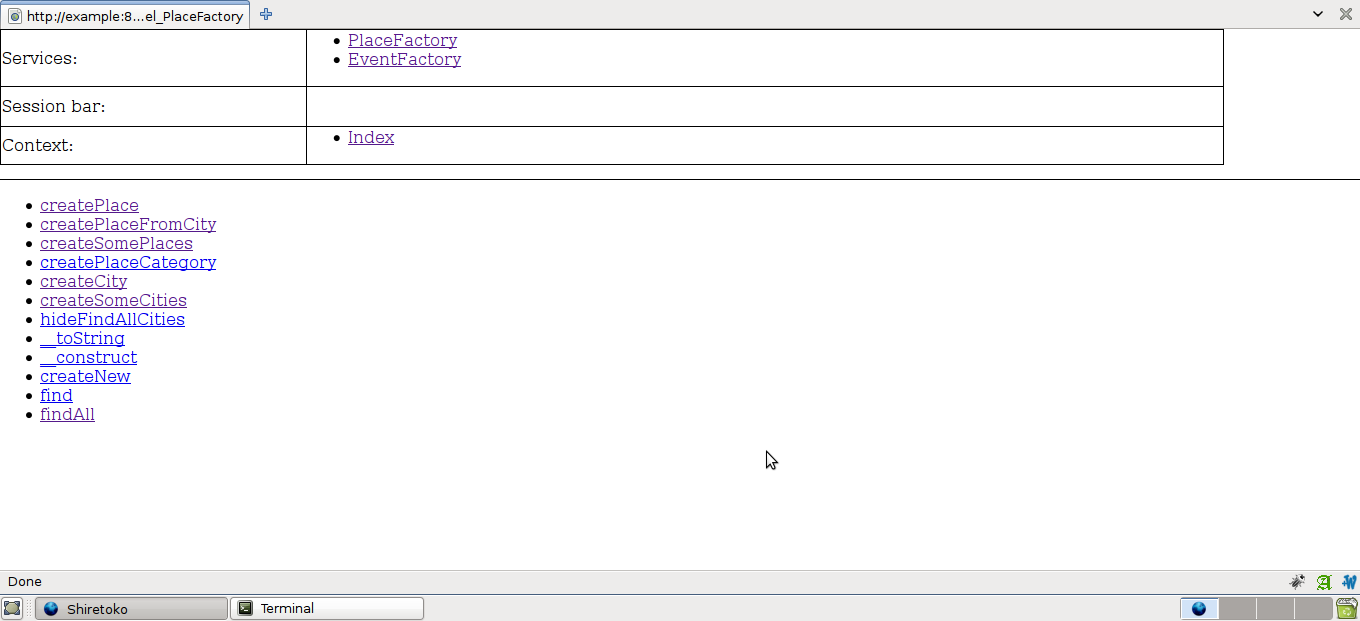
The session is now empty, and in the last screen we are already gone to the PlaceFactory object. We notice a new findAllCities action available. It has appeared now because there is a hideFindAllCities() method on Example_Model_PlaceFactory, which returns true until there are no cities in the database (Services has access to external infrastructure like storage and whatever we want them to use, while Entities usually have no external references since they have to be serialized.)
The findAllCities action brings us back all the cities stored in the database. This is an "object" - really an array, but every variable saved in the session is wrapped in a NakedObject instance.
The difference between a normal object and an array is that a wrapped array has a Collection Facet, and the views recognize this Facet and treat it differently. Particularly, they list the contained objects and provide access to them.
Finally, note that this Entity is managed and not transient, because it has been retrieved from the storage.
By clicking on the row of an item of the collection, the object is extracted in the session (it is considered transient because the semantic for the extracted objects has not been written yet. This will be fixed in the future.) It still refers to the same instance in the collection, so if we modify one we'll see the changes in the other.
We now see an example of method call with object parameters. The createPlaceFromCity action will take a City and create for us a new Place object with the city property already set. But we don't like the current cities: we want another one.
As it was the case of Entities editing, the context is conserved between different method calls. We have clicked on createCity and we are now creating Rome.
The new object is available for the original method call now.
And finally, the action returns a new Place object which is stored in the session. The city has been set correctly.

That's all for now. I have exposed a practical example of NakedPhp features and of direct manipulation of objects, which has been persisted, retrieved, and moved around.
Now I can go back to add other features, such as semantics for removal and extraction of objects, and a complete method merging feature. What do I mean? It will be useful to have the createPlaceFromCity method also on every City object, so that, given a city, it will present to the user a Factory Method for Places. In this case, we could have put the method on the Example_Model_City class, but such a method may require collaborators which we should not inject on City: imagine a sendByMail(City) or searchSimilar(City) methods which access mailers or the database. With method merging, any service method which has in its parameters an object of class A will be callable from A objects as well, with the particular A parameter automatically passed and hidden.

The method merging feature was already present in NakedPhp but is currently broken (if I had acceptance-TDDed it, it wouldn't have been.)
See you in April for NakedPhp 0.2 and some news!

Thursday, March 25, 2010

A NakedPhp walktrough

Today I'll present a walktrough in the NakedPhp example application, to show the direct manipulation of objects it provides, with features like calling methods and editing of Entity objects.
The example application manages a Domain Model that contains places (shops, sightseeings, and so on) and cities. Places have a directional many-to-one relationships with cities.
I will upload a screenshot for every step.The graphic is very basic, but it is not a responsibility of the framework. Every application can write its own layout, complete with style sheets, and assemble the content pieces differently.

Supposing we had set up correctly the example application, to start working we have to load the naked-php controller default action. In my Apache configuration I set up the public/ directory as the DocumentRoot of the example virtual host. There are really no differences with others Zend Framework applications.
The starting page shows in the header the two declared services (managed as singleton-like instances), an empty session and a context bar, which we can ignore for now. Classes of a Domain Model are divided in two parts: Services (always available and never serialized) and Entities (managed in the session bar and passed around). Factories and Repositories go under the Services umbrella, while ValueObjects for now are not supported because the underlying object-relational mapper does not support them yet.
Clicking on the PlaceFactory service in the header will send us to the object Example_Model_PlaceFactory, with a list of the available actions (exposed methods, not filtered for now):
If we click on createPlace, a new Example_Model_Place object will be created by this factory method. This methods has no parameters and creates an instance with default values. We are redirected to that instance, which now is in the session bar:
If we click again on PlaceFactory and choose the createCity action, a form will be shown since this method requires one parameter (the name of the city):
We insert London as the name and submit the form. A new object is put in the session bar and we are redirected to it as it is the result returned by the method. The session bar keeps object in the PHP session: we are not touching the database. This means that entities should be serializable, and this leaves us free to use Plain Old PHP Objects that do not extend any framework class. The only requirement is that the phpdoc annotations and a few other ones are present to determine the type of parameters and method return values.
After the creation and the redirect, a list of the properties of the Example_Model_City object is shown:
Note that the object different specifications (classes) are distinguished by different icons.
If we go back to the Default Name Place by clicking on it and follow the link on the pencil, an editing form is generated basing on the setters available on the object.
Note that the context bar now contains one more link (other than Index). When a form for selecting method parameters or objects fields is shown, the context is conserved. If we don't like the objects we have in the session, we can go around looking for better ones, or create them. In the example, we want to create the Eiffel Tower Place and since it is not in London, we need a Paris City object. So even if we are on the form, we simply go on the PlaceFactory service and select the createCity action again:
The context has grown again (it can be reset by going to the index if someone screws up.) Then we submit the form and we are redirected to the last action we were calling, the editing of the entity 1:
 
We can now select Paris for the city field and change the name to Eiffel Tower, then submit the form. Unfortunately collections are not supported and we will get an error, but the process works well until it encounter the events collection (not yet implemented). If we simply reload the index page and click on the newly renamed Eiffel Tower object, we'll see it has been correctly edited.
We have worked only in-memory and not had any interaction with the database yet. This post is getting long so I will show you tomorrow the second part of the walktrough, where we save these entities and retrieve them with a method that is hidden or shown automatically basing on the current state.

Tuesday, March 23, 2010

Introducing NakedPhp 0.1

I dedicated a bit of my time to develop a port of the Naked Objects framework for Java, which I named NakedPhp. Essentially, the Naked Objects pattern is the automatic animation of an object-oriented Domain Model via the generation of the user interface and of the persistence layer, both commonly sources of duplication and kitchen sinks for business logic. Naked Objects is a radical reinterpretation of MVC, where the Model is at the center and the other layers are inferred from it and customized. You will call methods and move objects around in such an application.
This is NOT yet another Php framework: NakedPhp leverages Zend Framework and Doctrine for all the stuff you would expect a normal framework to do.

Previous related posts
Naked objects, DDD and the user interface
A look at technical question on Naked Objects
Naked objects in Php
Where is business logic?

NakedPhp applies the same pattern to Php applications, and I have tagged its 0.1 release today (this is an alpha release.) The Api is borrowed from the original Java Naked Objects framework. This is by no means a complete framework, but it's a good start since its basic CRUD functions are already working.
NakedPhp integrates Zend Framework 1.x for the user interface management and Doctrine 2 for the persistence layer. As for all Doctrine 2 applications, it requires Php 5.3, which is why I don't have an online demo right now.
Links
NakedPhp 0.1 on SourceForge
Bug tracker
Git repository (view it online):
git clone git://nakedphp.git.sourceforge.net/gitroot/nakedphp/nakedphp

A simple example application realized with NakedPhp is provided in the released package, which uses a bundled sqlite database. An application for NakedPhp is just a plain old Zend Framework application with a controller that inherits from NakedPhp\Mvc\Controller, and that inits the Entitymanagerfactory (related to Doctrine 2) and Nakedphp resources with the mandatory options like the path to the model classes's folder. NakedPhp is very liberal about what you do in your application: it only generates the first-step views and leaves you the layout for customization.
I will write related documentation about how to hook NakedPhp in an application in the next days which I will store along with the code in the Git repository on SourceForge.
The behavior of the generated interface (which is not scaffolding: it's intended for actual use and not for being modified) is driven by annotations on the model classes and by methods with special names. For example, properties available on Entity objects are inferred from getters and their modification is possible if correspondent setters are present. Other methods are called when available to determine automatic hiding of properties and methods (hideName(), hideFindAllCities()), validation of data and so on.

The sample application provides a basic workflow for an hypothetical Domain Model for shops, pubs, or similar places. You can create Cities and Places, modify their properties, save them in the database, then clear the session and retrieve them via service classes. This is a direct interface to the Domain Model, without translations.
Intructions are included in the release for the super-simple setup of the example application (essentially running phing build-example).

Let me know if you are interested in a framework that writes the user interface for you. I know that the Naked Objects pattern is not appropriate for all situations, but the goal is to simplify the presentation of the real Domain Model to the user for certain kinds of model-driven applications. It is also providing a prototyping interface for Domain-Driven Design in Php.

Monday, February 15, 2010

Repositories in Doctrine

Jebb wrote to me asking information about the Repository pattern:
I read your blog at http://giorgiosironi.blogspot.com/and I found it very helpful. I develop applications using DDD and Zend Framework however for persistence ignorance, I use some basic Repository as interface for DAOs. May I ask you how to implement Doctrine ORM in the Repository?
As I explain in depth in my previous post about this pattern, a Repository is an illusion of an in-memory collection of all persistent ignorant entities of the same class. A Repository may be abstracted beyond an interface defining only the mandatory methods that make sense in the domain model.
How an Orm fits in this discussion? Very few repositories accomplish their tasks alone: most of them compose an underlying generic Data Mapper layer which is usually an Object-Relational Mapper which translates classes and objects in tables and rows. A generic Data Mapper such as Doctrine 2 provides all the possibly imaginable operations on the collection of entities, and the Repository abstraction decouples the other parts of the application from knowing anything about an Orm. This is the primary advantage of a Repository.

As you may have thought at the persistence ignorance reference, with Doctrine 1 there are no chances to implement a real Repository. Doctrine 1 does not provide persistence ignorance because it requires entity classes to extend a base abstract Active Record.
In Doctrine 2, repositories can be implemented as Plain Old Php Objects: simply injecting the EntityManager and other collaborators they may need in the constructor will suffice. A Factory can then encapsulate the new operators.
This is the standard Repository pattern: a Plain Old Php Object which aggregates whatever is needed to hide the persistence mechanism of objects.

Doctrine 2 also provides a facility to quickly implement Repositories, but the freedom of implementation of this approach is limited. The process is described in the Doctrine manual and it consists in:
  • extending an abstract class, which has a protected member $this->_em you can execute queries with;
  • annotating the entity class with the class name of the concrete repository class;
  • obtaining an instance with $em->getRepository('EntityClassName'): the EntityManager will create the object and automatically inject itself in the Repository.
Some notes on this architecture:
  • there is no entity-specific interface;
  • you extend an abstract class, which may be a cling because you want only some find*() methods to be available. However testing won't be affected since a concrete Repository will always involve a persistence mechanism.
  • it would be useful for having different repositories referencing each other via the EntityManager; but you may manually inject them instead, maintaining the original solution.
  • Doctrine 2 default Repository class is instantiated instead if you do not specify a subclass; if you use a lot of repositories and inject some of them in other service classes, the default implementation will be very handy. This would be a pro for taking advantage of the Orm support instead of using POPOs.

Wednesday, December 09, 2009

What everybody ought to know about storing objects in a database

Probably during your career you have heard the term impedance mismatch, which is commonly referred to the problems that arise in converting data between different models (or between different cables if you are into electrical engineering).
Usually the complete expression is object-relational impedance mismatch, which indicates the difficulties of the translation process between two versions of the same domain model: the former resides in memory and it consists in an object graph, while the latter is used for storage and it is a relational model stored in a database. The conversion between parts of both models happens many times while an application runs, and in php's case at least once for every http request.

Object-relational mappers like Hibernate and Doctrine are infrastructure applications which deal with the mismatch, doing their best to implement a transparent mechanism and providing the abstracted illusion of a in-memory model, like the Repository pattern. These particular Orms are the best of breed because they do not force your object graph to depend on infrastructure classes like base Active Records.
The connection between the two models is defined by the developer, by providing metadata about its classes properties: for instance you can annotate a private field specifying the column type you want to use to store its value. But what are the translation rules the developers provide configuration for? Here is a basic set of the tasks an Orm performs for you.
  • Entity classes are translated to single tables as a general rule, with a one-to-one mapping. The class private or public fields which are configured for storage define the columns of a particular table.
  • Objects which you pass to the Orm for being stored become rows of the correspondent table. A User class becomes a User table containing one row for every registered user of your website.
  • A primary key is defined by choosing between the existing fields or inserted ex-novo. Often as a requirement the developer should explicitly define a field.
  • Repeated single (or multiple) class fields become new tables, and the problem of representing them is shifted to representing relationships; in the domain model this kind of objects are Value Objects, which is semantically different from Entities, but databases only care about homogeneous data and such objects receive no special treatment.
  • One-to-one and many-to-one relationships can be represented with a foreign key on the source entity that resembles the original pointer to a memory location.
  • One-to-many relationships are a bit trickier because they require a foreign key on what is called the owning side, in this case the target entity. What can seem strange at first glance is that even if in the domain the relationship is unidirectional (pointer to a collection), elements of a collection need to have a reference to the owner to unequivocally identify it. The mutual registration pattern can be used to build a correct Api starting from this constraint; I will write about it in one of the next posts.
  • Many-to-many relationships are managed by creating an association table that references with foreign keys the participating entities. Every row constitutes a link between different objects; sometimes it may be the case to use such a table also for one-to-many associations, to avoid having a back reference field on collection elements.
  • Inheritance is by far the most complex semantic to maintain as it is not supported at all by relational databases: Single/Class/Concrete table inheritance are three famous patterns which organize hierarchical objects in tables, but I prefer to avoid inheritance altogether if not strictly necessary.
And this list is one of the reasons why in your college courses they told you that a model should be as small and simple as possible: a simple model can undergo much more simple transformations for storage and transmission than a complex one.
Note that some contaminations leak from the database side to the object graph, such as the bidirectionality of one-to-many relationships, present even when it is not required by the domain model.
Orms take care for you of this translation process and can even generate the tables from the classes source code, but they only perform automatically the tedious part of object-relational mapping. You should know very well how the mapping works if you plan to use such powerful tools without reducing your database to a list of key/value pair.

The image at the top is an Entity-Relationship model used to design database schemas. I find it not useful anymore as I now prefer to think in classes terms, with Uml diagrams.

Thursday, October 29, 2009

The Repository pattern

A Repository is a Domain-Driven Design concept but it is also a standalone pattern. Repositories are an important part of the domain layer and deal with the encapsulation of objects persistence and reconstitution.

A common infrastructure problem of an object-oriented application is how to deal with persistence and retrieval of objects. The most common way to obtain references to entities (for example, instances of the User, Group and Post class of a domain) is through navigation from another entity. However, there must be a root object which we call methods on to obtain the entities to work with. Manual access to the database tables violates every law of good design.
A Repository implementation provides the illusion of having an in-memory collection available, where all the objects of a certain class are kept. Actually, the Repository implementation has dependencies on a database or filesystem where thousands of entities are saved as it would be impractical to maintain all the data in the main memory of the machine which runs the application.
These dependencies are commonly wired and injected during the construction process by a factory or a dependency injection framework, and domain classes are only aware of the interface of the Repository. This interface logically resides in the domain layer and has no external dependencies.

Let's show an example. Suppose your User class needs a choiceGroups() that lists the groups which an instance of User can subscribe to. There are business rules which prescribe to build a criteria with internal data of the User class, such as the role field, which can assume the values 'guest', 'normal' or 'admin'.
This method should reside on the User class. However, to preserve a decoupled and testable design, we cannot access the database directly to retrieve the Group objects we need from the User class, otherwise we would have a dependency, maybe injected, from the User class which is part of the domain layer to a infrastructure class. This is want we want to avoid as we want to run thousands of fast unit tests on our domain classes without having to start a database daemon.
So the first step is to encapsulate the access to the database. This job is already done in part from the DataMapper implementation: [N]Hibernate, Doctrine2, Zend_Entity. But using a DataMapper in the User class let its code do million of different things and call every method on the DataMapper facade: we want to segregate only the necessary operations in the contract between the User class and the bridge with the infrastructure, as methods of a Repository interface. A small interface is simply to mock out in unit tests, while a DataMapper implementation usually can only be substituted by an instance of itself which uses a lighter database management system, such as sqlite.
So we prepare a GroupRepository interface:
<?php
interface GroupRepository
{
    public function find($id);

    /**
     * @param $values   pairs of field names and values
     * @return array (unfortunately we have not Collection in php)
     */
    public function findByCriteria($values);
}
Note that a Repository interface is pure domain and we can't rely on a library or framework for it. It is in the same domain layer of our User and Group classes.
The User class now has dependencies only towards the domain layer, and it is rich in functionality and not anemic as we do not have to break the encapsulation of the role field and the method is cohesive with the class:
class User
{
    private $_role;

    // ... other methods

    public function choicesGroups(GroupRepository $repo)
    {
        return $repo->findByCriteria(array('roleAllowed', $this->_role));
    }
}
Now we should write an actual implementation of GroupRepository, which will bridge the domain with the production database.
class GroupRepositoryDb implements GroupRepository
{
    /**
     * It can also be an instance of Doctrine\EntityManager
     */
    public function __construct(Zend_Entity_Manager_Interface $mapper)
    {
        // saving collaborators in private fields...
    }

    // methods implementations...
}
In testing, we pass to the choicesGroups() method a mock or a fake implementation which is really an in-memory collection, and which can have also utility methods for setting up fixtures. Unit testing involves a few objects and keeping them all in memory is the simplest solution. Moreover, we have inverted the dependency as now both GroupRepositoryDb and User depend on an abstraction instead of on an implementation.

Another advantage of the Repository and its segregated interface is the reuse of queries. The User class has no knowledge of any SQL/DQL/HQL/JPQL language, which is highly dependent on the internal structure of the Group class and its relations. What is established in the contract (the GroupRepository interface) are only logic operations which take domain data as parameters.
For instance, if Group changes to incorporate a one-to-many relation to the Image class, the loading code is not scattered troughout the classes which refer to Group, like User, but is centralized in the Repository. If you do not incorporate a generic DataMapper, the Repository becomes a Data Access Object; the benefit of isolating a Repository implementation via a DataMapper is you can unit test it against a lightweight database. What you are testing are queries and results, the only responsibility of a Repository.
Note that in this approach the only tests that need a database are the ones which instantiate a real Repository and are focused on it, and not your entire suite. That's why the DDD approach is best suited for complex applications which require tons of automatic testing. Fake repositories should be used in other unit tests to prevent them from becoming integration tests.

Also the old php applications which once upon a time only created and modified a list of entities are growing in size and complexity, incorporating validation and business rules. Generic DataMappers a la Hibernate are becoming a reality also in the php world, and they can help the average developer to avoid writing boring data access classes.
Though, their power should be correctly decoupled from your domain classes if your core domain is complex and you want to isolate it. Repositories are a way to accomplish this decoupling.

Wednesday, September 16, 2009

How to TDD a database application

After the publishing of Failed attempt to apply Tdd response, some readers have asked me how to test a database application, as an example of code which is not suitable for xUnit frameworks.

Let's start with saying that database is not a special case for testing, as it's only a port of your application. Whenever the application interact with an external program I would say it presents a port, and this pattern is called Hexagonal Architecture.
Your effort should be in testing thoroughly the core of the application, building a solid object-oriented Domain Model piece after piece, by writing a test at the time an making it pass. The Domain Model should not have dependency on any infrastructure like database, http requests, twitter adapters, and so on: this refinement of the Domain Model pattern is called Domain-Driven Design and when applied produces easy testable code. The Domain Model would be tested by injecting fake adapters as there should be no logic in the database: this is object-oriented programming and in database object do not exist nor we can test it easily and automatically with Junit.
Though, this approach is very complicated and it is considered when the domain has a rich set of rules and behavior, while many applications have only CRUD capabilities.

Think of your application as existing only in Ram memory and strip out all the unnecessary code. The classes which remains are the core of the Domain Model. For instance if I had to manage the list of the users of a forum, I would write initially only a User class and a generic collection of User objects. User in my point of view is a POJO or POPO, which does not extend anything:
class User { ...

Insulating the database from view will hide this generic collection behind an abstraction
, since it is not present at all in memory except for caching. Subsets of it can be reconstituted as needed. This abstraction is called a Repository or, at a low level, a DataMapper. Hibernate for Java and Doctrine 2 for php are example of a DataMapper pattern: they let you work on your objects and then take them and synchronize the database with the new data you have inserted: a change in a User's password, or new Users to be added. To polish the DataMapper Api, which is very generic, a UserRepository class can be created.
Even if you do not have a generic DataMapper, and work with mysql_query, PDO or JDBC queries, you can write a UserRepository which will act as the port for the database (or maybe a text file; since the repository decouples it, the storage mechanism can be anything from a memcache server to a group of monkeys which writes down on paper serializations of objects).
Depending on your architecture, your controllers or other domain classes will now have the UserRepository as a collaborator, and will talk to it and call its methods instead of accessing the database directly; this is a form of Dependency Injection. Obviously if there are other entities which are persisted, like Groups, Posts, etc. they should have their own repository class.

Of course the point of this discussion is how to test this code, since to write it we have to prepare a test before (it's called red green refactor and not code and then try to test). If we manage to write these tests first, the code will be automatically testable, and very decoupled and reusable as this is a characteristic of testable code.
What we need to write are not tests, but unit tests. If you want to check the entire path of data in the application, you can write integration tests which will exercise even the user interface, but Test-Driven Development prescribes to write unit tests: your test methods should have a dependency only on the system under test, and to the interface it uses.
Continuing our example, we need:
  • unit tests for User, Group, Post classes (Domain Model entities);
  • unit tests for controllers or other classes from the Domain Model which uses the adapters.
  • unit tests for UserRepository and similar classes (adapters);
  • unit tests for DataMapper or (infrastructure);
The point of unit testing is you can test singular components separately, and not the entire application as you would do with functional testing. Moreover, you must test each component separately or otherwise it would reveal too difficult to write classes to satisfy an integration test and the TDD benefits of adding a bit of design with every test method would be lost.
With this knowledge, we can say:
  • unit tests for Domain Model entities must be written by the developer of this application. If the project is mostly a CRUD application and is data-intensive, these test cases will be very short.
  • unit tests for controllers and everything that uses the adapters also must be written by the developer, mocking the adapters out. If you use the real adapters in testing, it will be integration testing and it will be heavy and brittle; you won't know if it's the controller or the adapter which does not work after a red test.
  • unit tests for the adapters concrete classes: this is the only interaction with the database. Fortunately, we are unit testing for this classes so we can even use a new database for every test method as every class will present a few methods; compare this approach with testing every single feature of the application by using a real database.
  • unit tests for infrastructure: these are included in the framework so we shouldn't worry.
Note that if you use a DataMapper which abstracts the particular database vendor as infrastructure, you can run the unit tests for the adapters by using a in-memory database like sqlite instead of the real database which will likely be very heavy to manage and recreate every time; this way, you de facto exclude database from your unit tests. Of course some integration tests will be necessary, but they are not part of TDD and of the design process.

I hope to have given you an idea of what unit tests means and how to deal with an application which uses a database for persistence, which is a very common scenario. Feel free to raise questions in the comments if something is not clear.

Do you want more? There's a book for .NET developers which explains DDD and database-independent testing.
The image at the top is a photograph of integrated circuits, which are real world components designed for testability and which are tested indipendently from the card where they will work.

Thursday, August 27, 2009

Applying Domain-Driven Design and Patterns review

Applying Domain-Driven Design and Patterns: With Examples in C# and .NET is a book from Jimmy Nilsson which shows you how to begin applying such things as TDD, object relational mapping, and DDD to .NET projects...techniques that many developers think are the key to future software development. Although it is based on .NET technology and features C# examples, it is a valuable resource for DDD adopting in every object-oriented language and one of the few practical books on Domain-Driven Design, along with the original one from Eric Evans.

The main feature of this book is a full description of the process followed in development: previous solutions are presented along with improvements to the object-oriented design and the reasons that have lead to refactoring. For instance, persistence ignorance is not assumed as the basis of a decoupled model but it is the final point of a research path.
This is a panoramic of the topics which the author deals with in the 600+ pages book.

Part 1: Background
The first part of the book is a introduction on low-level techniques like TDD, refactoring, and application of patterns (for example, State pattern). Problem and tradeoffs are discusses regarding databases and their impedance mismatch with an object-oriented model, together with the importance of layering and modelling. Part 1 is important because understanding of the rest of the book strongly depends on these concepts: a responsible programmer should test first and refactor where he expects changes.

Part 2: Applying DDD
In part 2 a full application requirements are discussed along with part of their implementation. Since the title is applying DDD the focus is on building the right model for the example, leaving out infrastructure and security concerns for a moment.
The requirements list comprehends orders and customers management, concurrency conflict detection, validation rules on amount of moneys in orders and customers, atomic saving and validation with an external service. This list is well crafted as it contains the main problems encountered when using a rich Domain Model, so the order management application is a good example to see DDD applied at its best.

Part 3: Applying PoEaa
While part 2 is centered on a persistent-ignorant model, part 3 discuss the infrastructure needed for the example application to work (object/relational mapping in primis) and tradeoffs from the incorporation of database concerns in the pure domain model. PoEaa is Patterns of Enterprise Application Architecture, a famous book from Martin Fowler which presents the principal patterns used in orms and big applications.
PoEaa is full of code examples so it is not important for the author to attach naked code but the discussion on how to persist a rich model is still crucial.

Part 4: What's next?
This part introduces other techniques and topics which are not strictly related to modelling and infrastructure: Service-oriented architecture, Inversion of Control and Dependency Injection, Aspect-oriented programming, Model-View-Controller pattern, user interface development. These are all interesting topics which a smattering of can only help the average developer to enlighten himself and face different ideas and paradigms: TDD for instance needs Dependency Injection to work.

Part 5: Appendices
Last but not least, other styles are proposed in contrast to DDD, such as database-driven development and rich service layers. The same application requirements from part 3 are rediscussed using these new point of views, and the reader gets a comparison between various implementation of the Domain Model pattern.
The appendices contain also a list of the patterns referenced in the book, but the should consider other sources for more information.

Summing up, Applying DDD is a good panoramic on practicing Domain-Driven Design, but also on implementing patterns and using modern tools and approaches like Dependency Injection and Test-Driven Development. It can also be read along or after the original DDD book to improve the understanding of Factories, Repositories and other domain patterns.

Friday, July 31, 2009

Global state is rarely a salvation

This post is a response to Domain Events - Salvation from Udi Dahan, where he shows a design to manage the Domain Events pattern. He suggest to use a static class to handle publishing and subscribing, but I argue that a static class solution is not pure as it seems.

Disclaimer: Udi Dahan is an authority in DDD and enterprise application development. I think it is a person who gets things done and I do not contest the validity of his approach in production environments. Active Record often gets the job done also and I used it a lot in the past, but there are cleaner solution arising.

In the Domain Events - Salvation post, Udi proposes the third reworking of his Domain Events implementation. DomainEvents is a pattern similar to Observer or Publish/Subscribe applied to a Domain Model, where the domain objects are observed or observers.
He sustains that you should not never inject anything in Entities, and I agree since Entities are not injectables. Here's how he raises an event:
public class Customer
{
public void DoSomething()
{
DomainEvents.Raise(new CustomerBecamePreferred() { customer = this; });
}
}
Then he says:
We’ll look at the DomainEvents class in just a second, but I’m guessing that some of you are wondering “how did that entity get a reference to that?” The answer is that DomainEvents is a static class. “OMG, static?! But doesn’t that hurt testability?!” No, it doesn’t. Here, look:
and he proceeds to show a (not) unit test where an event is raised.
Now, let's clarify some points:
  • a static class is more or less a singleton. They both have reset-like methods and a unique copy of data globally accessible wherever you want. You can make the class package-private in some languages, but every class have potential access to the singleton instance.
  • Singletons are pathological liars. They hide dependencies and carry global state around, between tests.
  • This solution uses a static class.
We can conclude that this Domain Events implementation is not a beautiful architecture as it was proposed. Let's explore the problems it raises:
  • If you forget to reset() the static class between tests, the test suite can blow up suddenly in a strage place and the fault will be hard to locate. An instance can fire an event that is forwarded to subscribers that do not exist anymore. This is global state in action.
  • Everytime you test an entity class, you're testing also DomainEvents class, since it cannot be mocked.
  • There is a compile-time dependency on DomainEvents. In other languages like Php this would not be a problem since there's no compiling, but Udi's examples use .NET and Customer is now dependent on DomainEvents. A possible solution would be defining events support directly in the language, but it is a big shift in the object-oriented paradigm.
  • Production code will be an action at a distance.
Let's explore the last issue.
The code of a service or controller layer will be similar to:
// in the setup
DomainEvents.Register(
b => creditCardProcessor.charge(b.Customer, b.Amount)
);
// Customer class, an Entity
public class Customer
{
public void bill(int amount)
{
DomainEvents.Raise(new CustomerBilled() { Customer = this; Amount = amount });
}
}
// some controller, client code
Customer c = new Customer();
c.bill(1000); //someone is billed? but who? what happens when I call this? if I not persist this customer instance nothing has happened, right? No.
compare it with:
billingService.charge(c, 1000);
or
c.bill(billingService, 1000);
The billing service does not lie: it requires a CreditCardProcessor in the constructor. Now I see what happens: the credit card of the customer is charged for 1000.
My solution is always the same: if a method of an entity requires an injected dependency, place it on a service class or ask for the dependency in the method parameters, extracting an interface to put in the signature. Asking in the constructor is fastidious since we want to be able of create stateful objects like entities simply by calling new, or whenever we create one we have to ask for a factory.

My conclusion is that using a static class in an entity class and say that you're not injecting anything is right, because you're not applying Dependency Injection at all. The phrase:
The main assertion being that you do *not* need to inject anything into your domain entities.
should be changed to The main assertion being that you do *not* need to inject anything into your domain entities: simply throw in a static class so that your entity stops asking for things and begin looking for things, abandoning Inversion of Control/Dependency Injection.
Again, I do not question that this design gets the job done. But don't say "I'm not injecting anything, that's good" if you're nail down a lightweight newable class to a static infrastructure one.

Wednesday, July 29, 2009

When to inject: the distinction between newables and injectables

Dependency Injection is a great technique for producing an application with decoupled components; but injecting every single object of any lifetime is not useful. Where do you find a Mail that sends itself?

In the last post, I introduced Dependency Injection and show useful cases where it allows classes decouplng. I also wrote about the problem of how to inject a service in a class that has to be instantiated not application wide but in the business logic.
class Mail
{
public function __construct(MailService $service)
{
...
}
}

class CommentsRepository
{
public function sendAMail()
{
$mail = new Mail(...); // what I should pass?
$mail->send();
}
}
The problem is that CommentsRepository sends a mail basing on some input data (if someone has posted a comment), so we cannot instantiate Mail at the bootstrap of the script like we do with CommentsRepository or other request-lifetime objects (session-lifetime in case of a Java application instead of a Php one).
The simplest solution is of course, to use a factory:
class CommentsRepository
{
public function __construct(MailFactory $f)
{
$this->_mailFactory = $f;
}

public function sendAMail()
{
$mail = $this->_mailFactory->createMail();
$mail->send();
}
}
This approach let CommentsRepository depending only on Mail and MailFactory (which could be an interface); dependency injection is correctly applied from the technical point of view. A Factory should be created for every object lifetime: the main services like an MVC stack are request-lifetime objects and should be create by an application factory, while other objects that are created during the execution should taken care by a smaller factory to pass where it is needed. Because a parameter in the constructor expresses dependency, CommentsRepository says that it creates Mail in its methods.
However, a factory for Mail trigger some problems:
  • Every time we create a mail, also for testing purposes, we have to use a factory for obtaining an instance, that shield our code from changes in the constructor of Mail. Considering that an instance of Mail is likely to be passed around as a method parameter and we'll need to mock it every time, this is a smell that the current design has some flaws.
  • In production code, if a class create a mail but does not send it, the former must use a factory and so is coupled to the mail sending classes. For instance, a collaborator of the CommentsRepository that creates a nicely formatted html Mail object.
  • Serialization of a mail to send it in another moment is not possible since at the wakeup it won't know where to find its MailService.
  • If Mail was a string, will you inject a StringFactory? I don't think so.
What is the problem? That a mail knows how to send itself. Have you ever seen a mail that sends itself, or a credit card that process itself (like Misko Hevery, the Google testing guru, denounce often)?
This lead to achieve a fundamental disctintion in business objects: Entities and Services. I write them starting with an uppercase letter to denote that they are precise concepts in object-oriented programming and the meaning of the two words is different from their use in common language.
  • Entities are stateful; their job is to maintain their state and to be saved (and not saving itself) in some place or in memory. Services are stateless: you can instance a MailService many times, but it is always the same service for the end-user.
  • Entities are newables, Services are injectable (this is Misko Hevery terminology). Entities should be create with new operator every time you need them, while Services should be created by a factory or a dependency injection container.
  • Services depends on entities, while the opposite should not happen. It can happen in some programming models when they are coupled to a Service interface.
With these distinction in mind, let's review our design:
  • Mail is an Entity
  • String is an Entity (it is a ValueObject, but in a pure Entity/Service distinction it is an Entity)
  • CommentsRepository is a Service
  • MailService is, obviously, a Service
How do we evaluate such a difference? Mail is a stateful object: we can change its subject, text, formatting. It must be a Entity. CommentsRepository have no properties that maintain a state - we cannot make our repository tall or short, thin or fat. The same is true for MailService: every time a factory creates it the result is always the same and probably it is a singleton in our application or there is a limit on the number of instances if is a generic class.
So Mail should knot know about Services, only Services could:
class Mail
{
public function __construct($title, $text)
{
...
}
}

class CommentsRepository
{
public function __construct(MailService $service)
{
...
}

public function sendAMail()
{
$mail = new Mail(...);
$this->_service->send($mail);
}
}

interface MailService
{
public function send(Mail $mail);
}
Now, CommentsRepository is tied to MailService interface, but it was already coupled indirectly by Mail when we started refactor. Mail does not know about anything, and MailService has a dependency on a concrete but small and compact class.
In the first refactoring, we treated Mail like it were a Service, but a similar deference should be adopted when dealing with more complex classes, while Mail is more or less a Value Object. If we wanted to create lazily the MailService, we would have inject a MailServiceFactory or a DI container in CommentsRepository. Beware of not slide towards an Anemic Domain Model, a procedural approach, putting methods that belong to Mail in Services: Mail is by the way a class, not a C structure or an array of fields.
Hope that this design satisfy you - it is very simple to test and loosely coupled as we should strive for every day.

Tuesday, July 21, 2009

Naked objects in Php

The validity of Naked Objects pattern, if implemented successfully, can add value to the php scene and help to answer the "Is Php ready for the enterprise?" question. Currently there is no framework to support this approach in the php world.

Php in the enterprise
The enterprise world has several architectural choices to build complex applications: Model-View-Controller frameworks are currently in vogue, especially in the php world, where Zend Framework, Symfony, Code Igniter, CakePhp and many others all implement this paradigm. But there are also examples in different languages: Ruby On Rails, Django for Python, Spring and Stripes for Java.
There is also a niche where developers are tired of bloated controllers and views that contains logic; they're also tired of dumping their own objects and get some megabytes of data because they have dependencies on all the instantiated objects of the chosen framework: here comes in NakedObjects.
As I wrote last week, the Naked Objects pattern let the framework take care of 3 of the 4 layers of an enterprise application: infrastructure, controllers and views are provided as generic or generated objects. The developer has only to write a Domain Model layer that follows some conventions.
Two frameworks that are named Naked Objects exist: one is written in Java and it is open source, while the other runs on the .NET platform; they are provided by the same people behind nakedobjects.org. Domain-Driven Design is really possible when using this tools.
I couldn't find a similar possibility for the average php programmer: it's a pity because php has the potential to introduce more and more cloud computing in the enterprise applications, let you use only a browser as a client.
There is also JMatter available, for Java.

Why wait?
So I decided to write a new one, a port of the Naked Objects for Java framework. It will have only a web interface anyway, since it is the best fit for php (no local GUI as it does not make sense).
Since I don't want to reinvent the wheel, it will incorporate Doctrine 2 (which I am contributing to) in the persistence part of the infrastructure layer and Zend Framework with its MVC implementation in the upper ones. Since the Naked Objects pattern has to be followed, the Views and Controllers will be provided from this framework, which I named NakedPhp. Obviously I chose an Open Source license, the bullet proof LGPL version 2; supporting DDD is also a key feature which I want to include.
Here are some links that points to the main resources activated on SourceForge to support the project:
Main page
Naked Php wiki
In-browser view of the Subversion repository
I will blog often about the architectural decisions of NakedPhp and its improvements, and when a alpha downloadable package will be available. Of course the repository is open to anyone who wants to take a look at the source code.
If you're tired to write controllers and views, consider the choice of a Naked Objects approach. And if you are a php developer and you want to participate, contact me!

Wednesday, July 15, 2009

A look at technical question on Naked Objects

Naked Objects pattern strips down the layering of your application to a single one: the Domain Model, and poses a lot of questions about how to implement the functionality that were present in the other layers.
As explained before, the Naked Objects pattern implies a framework that takes care of providing the other layers of an application in a completely generic manner, leaving you with only the responsibility to write a complete Domain Model. This raises immediate issues which are present in the original Pawson thesis and which I explain here with a language close to the developer who wants to use a Naked Objects approach, but is scared that it is only a buzzword for braindead, scaffolded user interfaces.
Here are the questions; the text in bold is quoted from the thesis, while the answers are mine.

How can the user create a new object instance, or perform other operations that cannot naturally be associated with a single object instance?
In a rich Domain Model there are Factories for the creation of objects when it is a complex procedure; otherwise, if it has a no-arguments constructor, it can be created directly by the framework. Thus, the new operator is wrapped in a method of another object, the Factory itself.
We have also Services, that connect business objects providing the operation which will cause coupling if placed on them. For example, a method called searchBooks(Author a) will be placed in a SearchingService class that will depend on Book and Author, but will not couple them to each other. In this case SearchingService could be a Repository.
However, the Naked Objects framework for Java take care of this and provides automatic injection of services in the business objects. Injecting in a newable object a service one sounds strange, since a common rule is that the entity should have a reference to a service only the stack (aka passed as a parameter), to allow the programmer to call new for it wherever he wants in the application.
Leave the business object free of the burden of a service is also possible, because by default every method of a service that has a particular domain object as a parameter will be listed in the user interface like it was on the object itself. In our example, the Author list of operations will show also list searchBooks(), passing automatically the object selected as actual parameter.

How does the concept of a generic presentation layer permit alternative visual representations of an object?
A unique visual representation is sometimes the best approach as it makes the application coherent. If this is really needed, the domain object can implements some standard interfaces of the framework that the generic user interface will recognize and use at its best.

How is the concept of a generic presentation layer compatible with the requirement to support multiple forms of user platform?
As long as the framework does the reflection work and provides metadata on the domain model, it is possible to implement many different generic presentation layers. The NO Java framework provides already a DragNDrop interface for local use and a web one, while there are many independent projects that features other interfaces to plug in.
If you really want, you can write manually a user interface: a side effect of working with the Naked Objects pattern is that the model is forced to be behaviorally complete and it simplifies the work of coding a user interface. In fact, usually a program does it for you.

With no use-case controllers permitted, how can naked objects support the idea of business process?
A REST guru will tell you: expose more resources, and instead of writing a controller to sends losts passwords via mail, you will produce a /lost-passwords/username resource that the user will POST or DELETE to.
There is no difference in a Naked Objects approach: you will produce a LostPasswordRequest object with some methods that once manipulated (with the aid of a mail service) will provide the desired behavior. The advantage is that the process will reside in the domain layer and it will be simpler to test; the skinny controller remains skinny as you cannot write it.
The objects like LostPasswordRequest are also called purposeful objects.

If core objects are exposed directly to the user, how is it possible to restrict the attributes and behaviours that are available to a particular user, or in a particular context?
Simply by conforming to an implicit interface, via duck typing. Where there is a setName() method, if sometimes this should not be used, the framework says to provide a allowName() method that returns a boolean. This is an implicit interface in the sense that the developer is not forced to implement a specific interface but only to write methods with signatures that follow a standard pattern. When the method is not present, a default behavior is provided.
Another option is to configure via an acl the single method access level, preserving some method only for certain admin roles.

How is it possible to invoke multiple parameter methods from the user interface?
Talking of the NO Java framework, the DragNDrop interface will not allow you to do this, suggesting to narrow down the parameters to one.* I think if a service method has two parameters it can be viewed as a single parameter one on the two business object involved, as I explained previously.
Not allowing methods with many parameters to be called in the user interface (they can be used internally but not exposed) will help keep the model simple, and introduce Parameter Object. However, the Web interface allow these calls providing a form to compile with the various parameters.
* Update: this is no longer true as the thesis was about the first version of the framework. So this point is not an issue anymore.

Naked Objects could be the next paradigm shift in object-oriented programming. Why writing four layers when you should write only one?

Saturday, July 11, 2009

Naked objects, DDD and the user interface

The SeparatedPresentation pattern is used to abstract the user interface from the domain model of an application. But it isn't more useful to enrich the user with a view of the domain itself?
The MVC pattern is all about separating the presentation of data. The major frameworks like Zend Framework and Rails are built to take advantage of an MVC stack, which means write your models, controllers and views.
Tipically we have a Post model with a PostController class that governs the operations that can be performed on the model and which views to show.
But there's more than MVC in the world.
What I'm talking about is Naked Objects pattern, that is currently implemented in the Java and .Net world by a framework with the same name. This pattern can be the next paradigm shift in development: in short, the V and C from MVC are completely generic and are built from the M part, the model classes. Also the infrastructure part, like database persistence of entities, are taken care by the framework that includes an Orm in its libraries.
Let's discuss the advantages of this approach:
  • there's no mapping between concepts, as the user interface is automatically created on-the-fly or generated and the user gains insight on the model (and thus on the domain). A driver aware of the fact that there is an engine will use the accelerator at its best. This helps an Ubiquitous Language to take shape.
  • there's no views and controllers to write, obviously.
  • there's no infrastructure coupling, also obviously if we exclude the annotations or xml metadata needed to make Hibernate or another Orm work. ActiveRecord is a reminescence of the past.
  • there's no logic in the controllers: they are automatically generate and delegates to the model. Fat model, skinny controller is achieved by force.
  • the domain model will be built without caring much of the other parts because it is the only thing to write. This allows a DDD approach, and the only attention is to conform to the conventions of the framework.
  • no more repeated validation on the ui: it is simply delegated to the model, where it should reside.
  • if the generated user interface does not satisfy you, what remains to you is a powerful and complete domain model that can be used to write an MVC application (thus using naked objects pattern only to prototype).
There are also issues of giving a complete user interface that cannot be edited by hand: this is not scaffolding. In the next posts I will talk about my journey in learning to use Naked Objects framework for Java, which is distributed as open source software.

Monday, July 06, 2009

Becoming a Doctrine 2 committer

In the last weeks I started to contribute with code to the Doctrine project. Doctrine is an Orm and database abstraction layer for php: it is the default orm for Symfony but it's not coupled to it and I integrated it successfully with Zend Framework. It is a good tool for abstracting the database layer and manage the persistence of the Model part of a MVC paradigm, which to me Zf does not very well with its Zend_Db component.

After opening tickets and upload patches for Doctrine 1.x for some months, I took a glimpse of the potentiality of the 2.x branch (that currently is not even in alpha). The code is in the trunk of the Doctrine repository and borrows concepts heavily from Hibernate:
http://trac.doctrine-project.org/wiki/Doctrine2.0
While Doctrine Query Language, based on Hql, was already present in the currently stable 1.x branch, the new Doctrine infrastructure is based on the Unit Of Work pattern instead of the old Active Record one.
The Active Record pattern is very famous and is used for example in Rails. It is the most simple solution of object relational mapping, which defines a class for every table of the database. A row is represented by an object of that class, that is subclassing Doctrine_Record/ActiveRecord depending on the framework and language you are using.
The Unit Of Work pattern does not substitute by itself the Active Record one, but it's part of the solution of refusing to have the domain objects depending on the infrastructure, in this case the mapping classes. This is very clean from a design and testing point of view as the most complex logic of an application resides in the domain classes (the User and Phonenumber ones for instance), and Doctrine 2 let the developer concentrate on writing and testing these models without (almost) taking into account where they will be persisted; how to map these classes is specified in annotations or via other metadata.
If you have written a bit of code you will probably find very interesting these solution, that is already used in Hibernate for the joy of Java programmers.

Said that, I really want to help the project as I dream of doing Domain Driven Design in php and persistence ignorance is a key point of DDD. So I asked how to start contribution to the project and the last week I've written eight test case class for phpunit plus the example model classes that they use. I was helped by Roman Borschel, the lead developer for the 2.x branch, that teached me how to use annotations properly and fixed my faults in the model classes. Keep in mind that contributing to an open source project you use or will use is a win-win situation because it helps the project going forward and obtain feedback, while it helps you to learn to use the tool well. And I will certainly use Doctrine 2 because I think it along with Zend Framework will kick Rails in the ass.

This monday, I have succesfully closed ticket #2276 and I look forward to learn more and go further. If you are a php developer, come to #doctrine-dev on the irc server freenode.net, or stay tuned to try the alpha releases of Doctrine 2 that will come in the future. Having a real domain model, free of dependencies versus concrete orms, is a dream of the php world that will be realized.

Featured post

A map metaphor for architectural diagrams

It is a (two-dimension) representation of a pipe. The map is not the territory , but in software engineering terms they are models of it....

Popular posts